


👋 Welcome to A World Reconfigured - your guide to a world changed by climate, geopolitics and technology. I write about how climate change is creating a new world with new rules, and often cover topics like the ❄️Arctic, 🤷♂️Rare Earths and 💻Data Centers.
If you happened to receive this email from a friend, please consider subscribing. If you’re already a part of this community, I’d love it if you could recommend it to a friend.
TL;DR:
President Donald Trump was busy while I was on vacation: Threats to annex Greenland (and then making a U-turn), establishing the Board of Peace, forcing PJM to auction record amounts of tenders and many more things.
My takeaway is, of course, never to go on vacation.
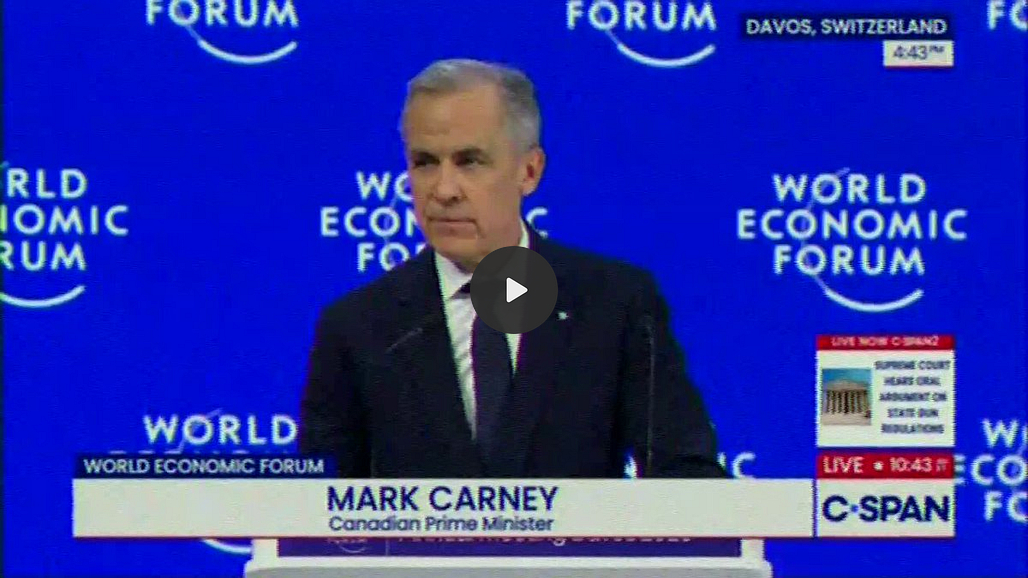
Still, it looks like the show at Davos was stolen by none other than Mark Carney:
Mark Carney’s speech at the World Economic Forum (Davos) took the Twittersphere by storm. Within minutes, a flurry of takes flooded the internet, followed by a SubStorm of analyses. I can’t blame them - by all respects, Carney’s speech was eloquent, refreshing and powerful.
Most commentators from all ends of the spectrum mostly focused on his announcement that the rules-based order is gone. For example:

I think that most of the commentary focused on the wrong part (or, the less interesting one).
The more interesting part, in my view, is Carney’s prescription to what comes next, after we’ve passed the rules-based international order. Spoken like a true Canadian, instead of spewing fire, Carney politely offers Middle Powers a way forward that isn’t a binary choice between US and China.
Carney’s speech is packed with issues to unpack - from the rupture to liberal values and cooperation in a fragmented world and I do not intend on covering everything. Instead, I will focus on Carney’s recommendations for Middle Powers and what they can do to keep their autonomy, while not paying too high of a price.
Buyers Club in a Fragmented World
The prescriptive part of Carney’s speech is as simple as it is refreshing:
In a world of great power rivalry, the countries in between have a choice: to compete with each other for favour, or to combine to create a third path with impact. We shouldn’t allow the rise of hard power to blind us to the fact that the power of legitimacy, integrity and rules will remain strong if we choose to wield it together.
…
Collective investments in resilience are cheaper than everyone building their own fortresses. Shared standards reduce fragmentations. Complementarities are positive sum. And the question for middle powers like Canada is not whether to adapt to the new reality – we must. The question is whether we adapt by simply building higher walls, or whether we can do something more ambitious.
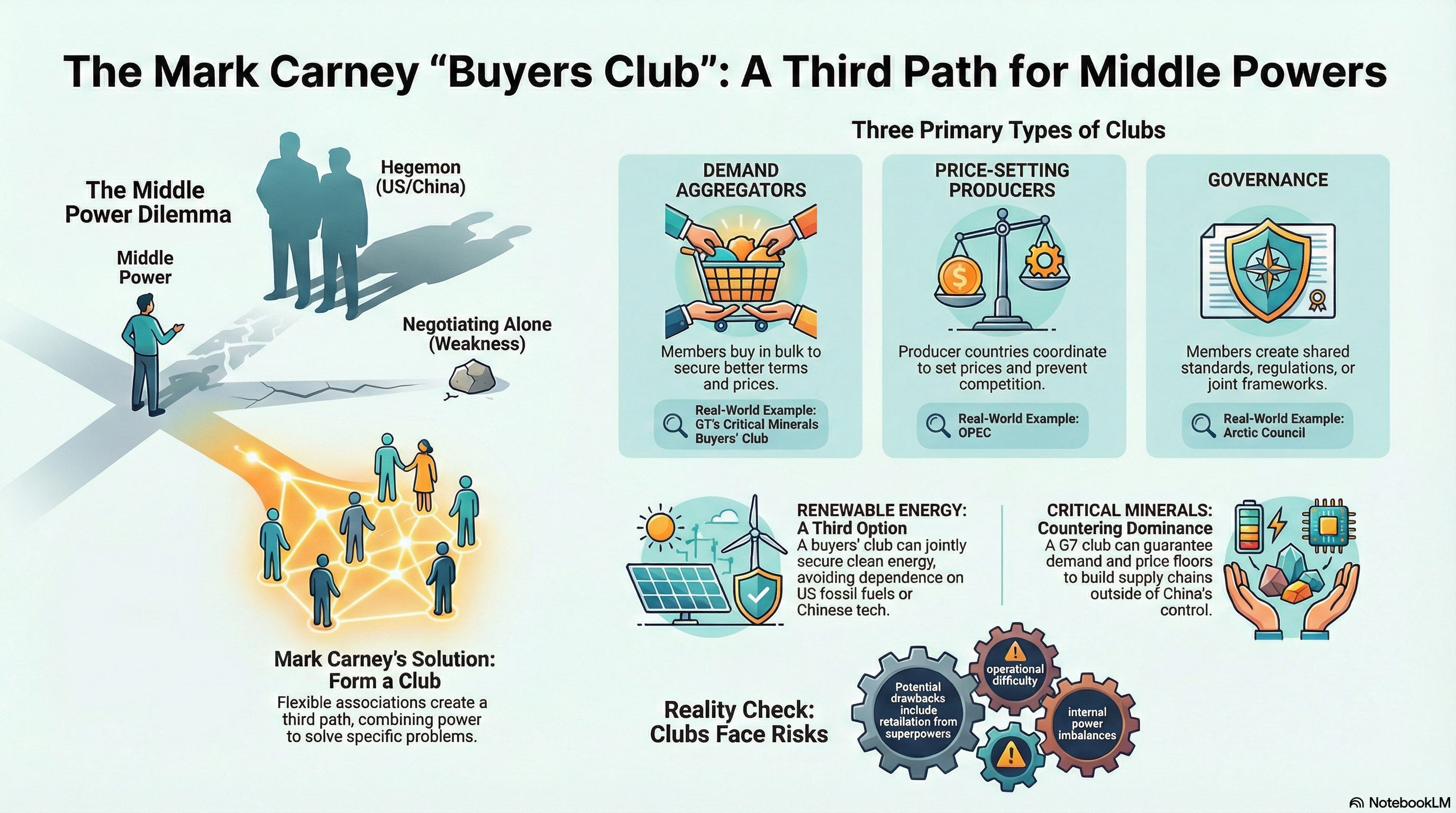
In other words, Carney suggests that instead of building fortresses in a fragmented and lawless world, they should form flexible and topical associations to fix specific issues.
Instead of signing grandiose proclamations and complex global treaties, “middle powers” should look to formulate more focused arrangements that can solve problems, while aggregating supply, demand or bargaining power.
The important question is - how?
Carney’s answer: Join a club.1

Join the Club
International clubs were always around, we just didn’t give them much attention. They are useful instruments to deal with specific issues that matter to a group of countries, or where specific coordination is required.
What all clubs have in common is that they are:
Closed to a set group of like-minded countries2
Enable coordination on a specific topic
Enable collective bargaining power and aggregation of supply or demand
Great for your skin
Examples of clubs in the international arena abound: OPEC, G7/20, Pax Silica and the EU are types of clubs. Even the Arctic Council is a form of a club.
Not all clubs are the same. While there are probably more than three types of clubs, we can think of three primary types that countries like to use:
Demand Aggregators: Clubs that are used primarily to buy in bulk and provide better terms for their members. This is a similar dynamic to what happens in the private market. For example, G7’s Critical Minerals buyers’ club.
Price-Setting/Producers: Clubs by countries that produce something, using their status to coordinate prices and prevent a race to the bottom or price competition. The most notable example is OPEC, of course.
Governance: Clubs that exist to create standards, regulatory regimes or create joint governance frameworks on a topic of collective importance. For example, the Arctic Council or the EU (at least in some respects)
In practice, each one of these clubs uses different mechanisms to achieve a goal. Mostly, it is to either promote a topic (say, decarbonization) or secure an advantage for its members (say, better prices).
For example, Demand Aggregators can provide favorable terms to suppliers or guarantee sufficient volume worth their while. In energy, club members can guarantee project developers sufficient offtake agreements3 from enough actors to make a project both economically viable and bankable.
Governance clubs can set standards for an industry or for behavior. The Arctic Council rules by consensus, setting a standard that countries cannot make unilateral decisions about the region and should work in unison with other Arctic nations:

Clubs In the New World Order
Clubs have existed for a long time and have served countries for multiple purposes. In a world that is governed by the rules-based order we all know and love, the formation of clubs is not seen as a breakaway from the mega-club that is the world order, but rather a club-within-a-club (like a nesting doll).

Now that this order is breaking down (at least, that is what everyone is saying, so it must be true), the general tendency is for each country to align itself with a hegemon (US/Russia/China and maybe even India).
In this kind of world order, it is assumed that smaller countries have to abide by the will of the hegemon. It’s the geopolitical version of My Way or the Highway.
Clubs, in essence, can help create an alternative for middle powers, like Canada:
But I’d also say that great powers, great powers can afford for now to go it alone. They have the market size, the military capacity and the leverage to dictate terms. Middle powers do not.
But when we only negotiate bilaterally with a hegemon, we negotiate from weakness. We accept what’s offered. We compete with each other to be the most accommodating.
Carney’s approach is particularly refreshing, compared to majority of accounts that spell the rise of Great Power Rivalry. Carney’s approach:
Provides us with a third way (spheres of influences vs. lawlessness and global anarchy)
Creates a more modular and nuanced world order, one that is ruled by power, but is offset by ad-hoc coalitions that come together based on shared interests and values
Gives analysts more stuff to write about
Middle powers are the primary beneficiaries from Carney’s speech. They are the ones who will use clubs to fulfil their goals and gain benefits, while creating alternatives that can be leveraged in dialogue with their hegemon. Canada, for instance, can use clubs to gain enough leverage to meaningfully negotiate with the US and therefore maintaining their sovereignty and autonomy.
The interesting aspect of Carney’s approach is that while clubs seem like a collaborative effort, in Carney’s approach it is meant to provide members with strategic autonomy, while maintaining values and liberties. In fact, Carney’s call for a more collaborative world rests on the assumption that going at it alone makes no sense from the individual perspective of middle powers. They simply cannot go it alone, in his words.
Now, let’s look at two particular examples: Energy and Critical Minerals.
Renewable Energy
Carney briefly mentioned Energy as an area for middle power collaboration.
While his track record with clean energy is far from perfect to say the least, Carney can create a buyers club that will aggregate demand and provide significant offtake agreements to renewable developers.
In practice, this club would issue joint tenders for wind, solar, storage or nuclear, provide incentives to developers and provide long-term contracts to suppliers in larger volumes than any one country can sustain. In exchange for the bankability and proven demand developers need to keep investing, club members can gain better prices and more leverage over how their counterparts behave.
Canada can also choose to take the governance path and work with other Middle Powers to set standards for Carbon Credits, Methane or other topics of collective interest that require coordination to achieve progress.
An energy buyers’ club would improve the strategic autonomy of its members by setting up more durable avenues to procure energy at more favorable prices, and would also prevent reliance on powers like Russia, US or China.
On renewables, Canada is stuck between a rock and a hard place: Washington is leaning on allies to keep fossil fuels in the mix, while Beijing’s massively subsidised clean‑tech machine now supplies over 80% of the world’s solar hardware and can undercut Western panels by half.
A buyers’ club would give Canada and its peers a third option: Jointly commit to volumes of clean power and equipment from a more diversified set of suppliers, and use that pooled demand to negotiate standards and prices that don’t leave them dependent on either camp.
Critical Minerals
Critical minerals are everyone’s favorite topic.
Carney referred in his speech to the G7’s Buyers Club on critical minerals, led by Canada. This club is meant to guarantee demand, set price floors, and co-invest in projects to counter China's dominance. Already, Canada committed to a $6.4B CAD, G7-backed package for 26 critical minerals projects and long-term purchase commitments and price floors.
This Buyers’ Club is somewhat similar to the US Mineral Strategy I covered just a month and a half ago:

China’s dominance of rare earth elements and many of the important critical minerals allows it to manipulate prices, flood the market and destroy competition. China also has an advantage in its ability to integrate minerals into final products thanks to its developed production ecosystems (e.g., rare earth complexes in Baotou, China).
In contrast, the majority of countries cannot afford to guarantee price floors in volumes that would move the needle or establish processing facilities at a scale that can allow them to break free from China’s hold on minerals.
In fact, the similarity between the US strategy and the G7 Club proves Carney’s point: Great Powers can do it alone; Middle Powers need clubs.
What would a Buyers’ Club give Canada? It would enable member countries to develop their own collective ecosystems, ensure that their industries can withstand price manipulation through price floors and incentivize new facilities. In other words, it can help a collection of companies adopt strategies that so far have been reserved for Great Powers.
Think of a Canadian nickel mine and refinery that only gets financed because a group of G7 governments guarantees a long‑term floor price for a big chunk of its output.
Another example could be club financing of processing hubs in friendly jurisdictions. For example, G7 governments can take a minority stake in processing plants or finance the establishment of a new one, so the ore doesn’t have to sail to Baotou to become useful. This is not too different from what the US is doing on its own over the past few months.
Clubs and Their Discontents
Carney’s approach is refreshing and powerful, but not without its faults.
Clubs have significant drawbacks and plenty can still go wrong:
Clubs can backfire: Pissing off hegemons is a tricky business; using clubs to hedge and build alternatives can easily trigger retaliation from the hegemon near you, whether through trade measures, regulatory pressure or security “reassessments.”

Clubs can still not be enough: In practice, it is brutally hard to diversify away from hegemons; even a G7‑scale buyers’ club is unlikely, on its own, to break China’s grip on critical‑mineral processing or rare earth separation anytime soon.
Clubs are hard to operate: Setting standards and providing offtakes sounds great on paper, but it demands tight coordination, long‑term political alignment and a lot of boring implementation work; over time, operations are likely to matter more than ideals, values or even stated interests.
Clubs can create bad power dynamics: Clubs are not democracies, even when their members are; power imbalances, agenda‑setting by the biggest players and winner‑takes‑most dynamics can turn a “middle‑power tool” back into just another hierarchy with better branding.

Looking Ahead
Carney’s vision of the future is not without its faults. There’s plenty to critique, from arguing against his view to blaming him of being a part of the reason we got here.
Still, Carney offers a real way that sidesteps the usual dilemma: US or China. Choose this or that.
I’ve mostly left out the values piece of his speech. I still think liberal norms are crucial for a prosperous, safe world, and clubs don’t magically guarantee them. There are illiberal clubs like BRICS, and Canada’s own deal with China is part of what set off the Twitter storm around Carney in the first place.
Even so, I still believe Carney offers a real way forward to maintain a form of the current world order, with clubs being a helpful instrument to keep some semblance of stability.
The Club approach can also provide some operational benefits compared to the complexity of multilateralism. Clubs, then, offer us a real way forward to better manage a post rules-based-order world.
Let’s hope he’s right.
Thanks for reading! If you enjoyed this edition, don’t forget to subscribe or share your thoughts. 🔽
See you next week!
I use the term club figuratively. Some of the associations Carney refers to are not exactly clubs, but function as such in practice. Some arrangements are bilateral, especially with hegemons (e.g., China), but many of them are inherently clubs.
There is much debate whether multinational corporations can be actors under international law, but for the purposes of this post, let’s pretend they can’t 🤷♂️
Investopedia defines offtake agreements: “They establish legally binding contracts between producers and buyers to sell future products, which helps secure necessary funding for construction or expansion projects. These agreements not only guarantee a market and steady revenue stream for producers but also provide price and supply stability for buyers, especially in volatile markets such as energy and natural resources.”