


👋 Welcome to A World Reconfigured - your guide to a world changed by climate, geopolitics and technology. I write about how climate change is creating a new world with new rules, and often cover topics like the ❄️Arctic, 🤷♂️Rare Earths and 💻Data Centers.
If you happened to receive this email from a friend, please consider subscribing. If you’re already a part of this community, I’d love it if you could recommend it to a friend.
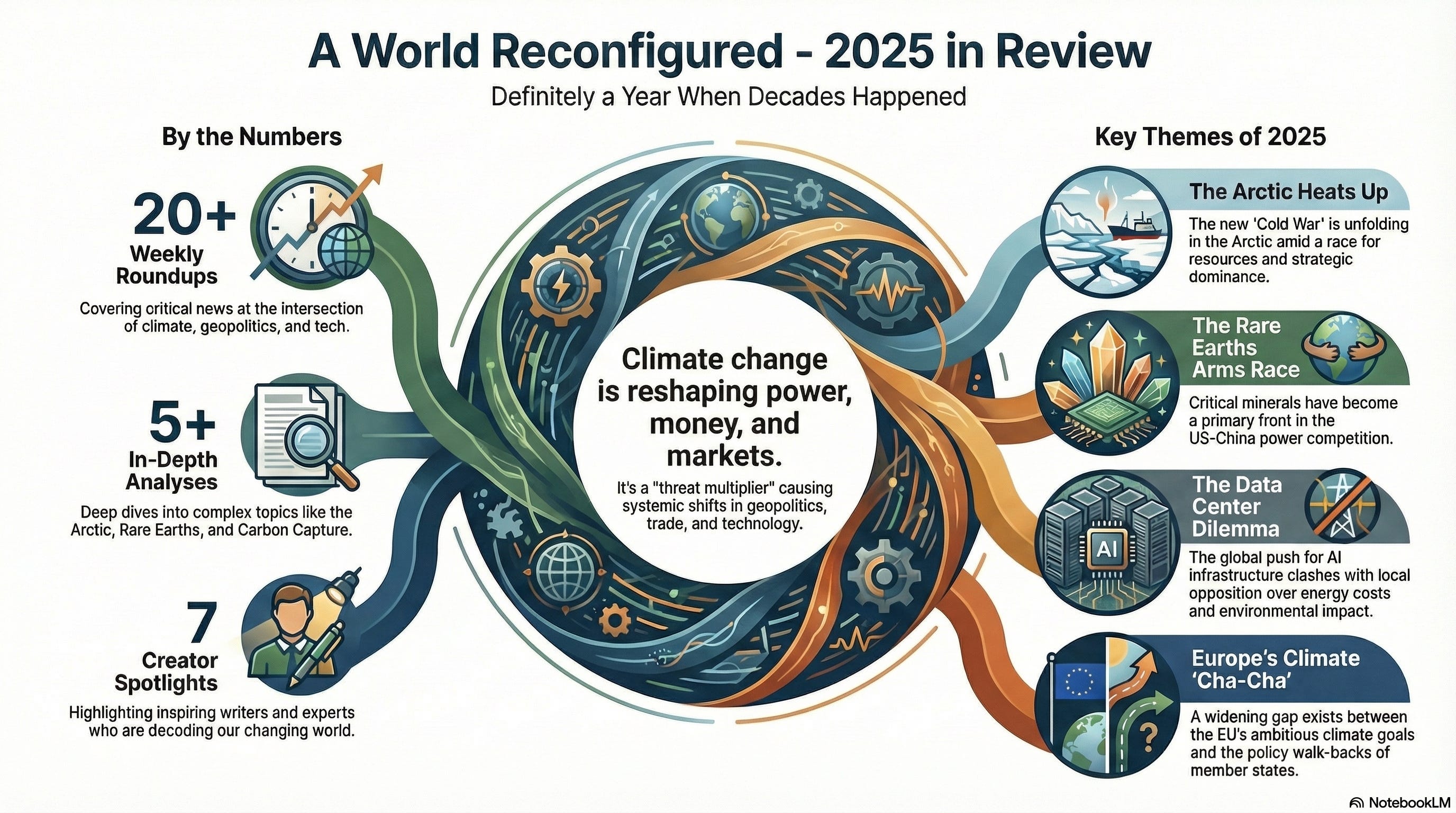
2025 is pretty much over, and you know what that means: A recap.
There is a quote I often use to try and impress upon those unfortunate enough to catch me in the musing kind of mood:
There are decades when nothing happens; and there are weeks where decades happen.
2025 was definitely a year when decades happened, and I count myself fortunate to be able to track, think and write about all that transpired. It was also the year I started seriously writing A World Reconfigured.
In the spirit of recaps, here’s mine: Personal reflections, 2025 recap, 2026 predictions and some of my favorite recaps!
Personal Reflections: I Started a Thing
I started this blog to tell stories that took place at the epicenter of a global rewiring of political, economic and human systems.
The world we live in is incredibly complex and nuanced, and it is impossible to tell every story. A theory of everything is more often than not a theory of nothing. So, I made a choice to focus on Climate Change as the key driving force that’s at the center of my coverage.
This year has been incredible on a personal level: Writing gave me an outlet for my thoughts and ideas. I’ve always been a macro kind of person, but never had a platform I felt all too comfortable with. This year has changed it for me.
In more ways than one, I cannot seem not to do it. I am excited (and also a bit terrified) about what I see out there:

This blog also helped me reduce my AI anxiety. The constant tinkering, generating and experimenting with AI made me more confident about the coming future and my role in it.
I feel like this year I’ve found my voice, and I’m excited about continuing to shape it in 2026.
So, before we go any further, I want to thank every single of one of you for reading this newsletter and for putting up with my nonsense being a part of my journey. I hope to continue and grow this community in 2026!
Ok, let’s dive right in!
2025 Recap + 2026 Predictions
Throughout the year, we explored many different fronts: from the Arctic to the US to China. We covered geopolitics, policy, climate investments and technology.
It would be impossible to mention everything that took place, but here are some of they key developments this year that caught my eye, and are likely to keep us busy in 2026:
US Policy Does a-180
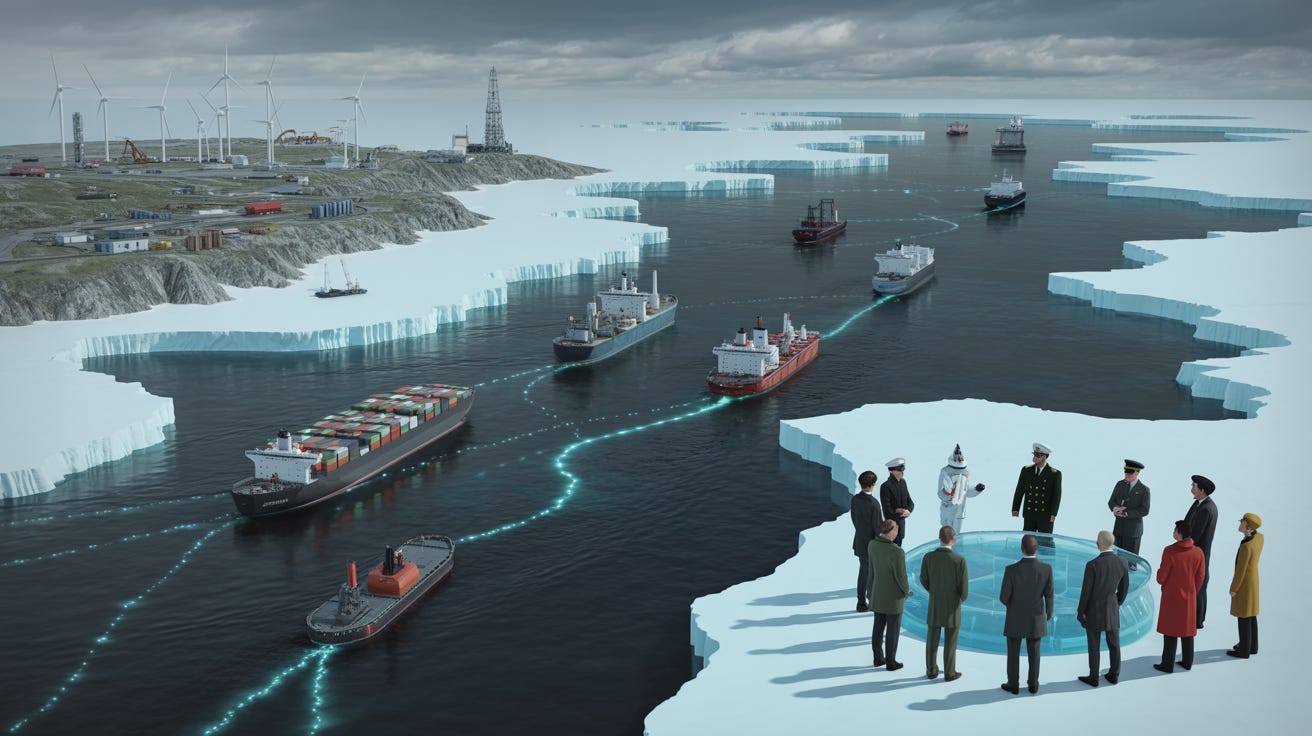
Perhaps the turning point of the year – and maybe of the decade’s second half – was Washington’s whiplash on climate and energy. The Trump Administration rewired US policy around “energy dominance” (less climate, more energy), moving with startling speed to gut Biden-era climate and clean‑energy programs and even older protections.
What we’ve seen this year is a complete overhaul of the executive branch and some of the legislative basis of climate policy, from the Dept. of Energy to the Environmental Protection Agency to NOAA to National Renewable Energy Lab. We have also seen aggressive action against solar and wind (wind was especially hit hard).
And yet, even the speed and scale of the Trump offensive against climate policy cannot reverse the expansion of renewables, both globally and in the US.
Record demand for energy made utilities, Hyperscalers and corporates take the “All of the above” approach extra seriously, inking many renewable deals. Some markets don’t care very much about the federal tune. For example, in Texas, solar and batteries generated record energy this summer.
To put it in Galileo’s words: E pur si muove (“yet it moves”)1
🔭In 2026, I don’t think anything will change on this front. If anything, the Trump Administration will continue to unravel climate policy and advance what it sees as Energy Dominance. At the same time, it’s likely that renewables will continue to expand, especially as demand for energy continues to grow against the backdrop of the AI boom.
The Arctic
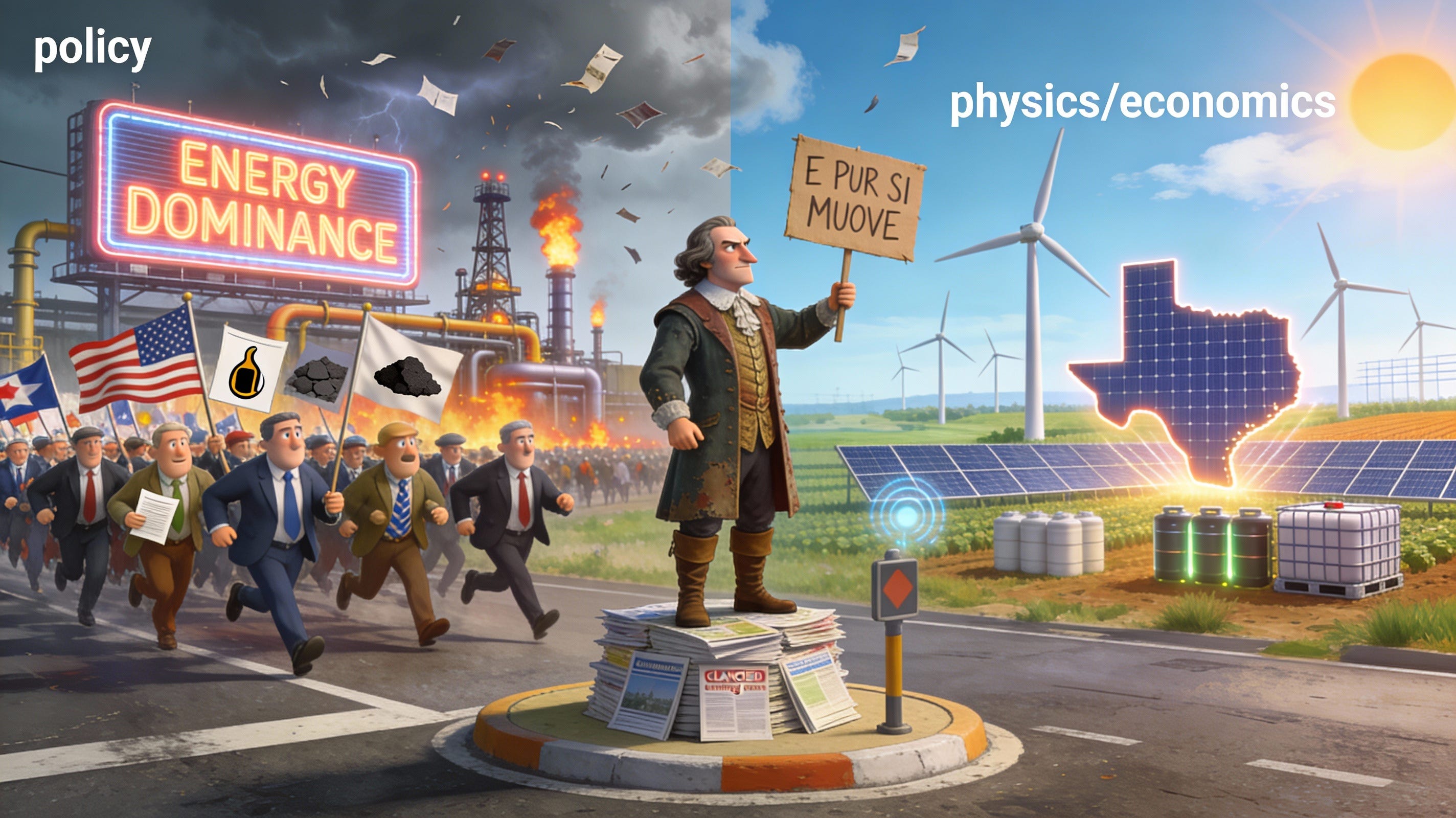
In 2025, the Arctic continued to march towards becoming the new South China Sea.
As the region is heating faster than anywhere else on Earth, permafrost thaw and dramatic ice loss continue to open new sea lanes and invite talk of mining (though not everyone agrees). In response, Arctic nations and non-Arctic states are making moves to further their interests, causing a shift from cooperation to tense coopetition.
The growing tensions in the Arctic were central to my coverage this year (ok and in late 2024):

Here are a few highlights of the year:
The US openly eyed Greenland as a geostrategic asset, to the growing alarm of Denmark and pretty much everyone else:

Russia has signaled in more ways than one that it intends to focus on the Arctic in coming years, while continuing military buildup in the region (including building floating ice bases) and preparing for hybrid warfare over Svalbard
China kept its partnership with Russia alive and showed no sign of abandoning the Polar Silk Road concept:

NATO stepped up exercises and presence in the High North, largely in response to Russian and Chinese assertiveness.
Countries like Norway, Denmark and Finland updated their security doctrines to reflect the Arctic’s shift from quiet periphery to front‑line theater.
🔭 In 2026, I expect we will see more of the same: power will keep reconfiguring as states move to leverage their Arctic advantage, and actors like Russia will keep testing the edges with shadow fleets and gray‑zone tactics along newly thawed routes.
I suspect we will see a bit more Arctic maritime traffic, especially around the Northern Sea Route. On resources, not so fast: despite the hype, the Arctic’s brutal conditions mean most projects will remain aspirational for years, and that’s probably for the best.
Arctic governance will continue to function on the surface, but underneath it will continue to fray. As more countries join attempts to take advantage of the region, we will likely see more bilateralism and alternatives to the Arctic Council.
On that note, will we see more countries jumping on the Arctic bandwagon? India, South Africa, Indonesia and Argentina in the Arctic? Sure, why not!2
I guess 2026 will be another hot year for the Arctic.
Critical Minerals and Rare Earths
In October 2025, thanks to the escalating US-Chinese trade war, China decided to turn up the heat on Rare Earth Elements export controls to 11. This move helped launch 17 relatively obscure yet important elements into global stardom.
This was the moment when the Western world - nations, companies and even everyday people - woke up to witness the outcome of nearly 40 years of disciplined Chinese industrial policy and Western negligence, resulting in almost complete dependency on China for rare earths, which are critical for anything from wind turbines to F35s.
In short, China found where it hurts, and it pressed on and on and on.

This moment also launched a flurry of deals, announcements, frameworks and agreements meant to counter China’s dominance. It also led to an emergence of a new US strategy:

The US and its allies are trying to achieve mineral independence, and they are investing like there’s no tomorrow. If they won’t, there might not be one.
It was not all that great for China. Inadvertently, China showed its hand and caused many countries to speculate whether China was in fact the adult in the room. In its willingness to weaponize export controls, China stoked fears in the hearts of countries and drove them into the arms of the US.
🔭 In 2026, I think we will see the US and its allies continue to rebuild its supply chains and their ability to achieve mineral independence. 2025 was a wake-up call for many countries, and I suspect they will try to realize their ambitions in 2026.
The US and its allies will try to continue to build more refineries like they announced in Romania and Saudi Arabia, to create more bilateral and multilateral frameworks like Pax Silica, and more. I will also not be surprised if we see more tech investments in new processes and recycling.
China is not likely to sit still. The more Beijing feels it is at risk of losing its edge, the more it can reach for price manipulation, tighter export controls and other familiar levers – and use BRICS and Belt‑and‑Road forums to build counter‑coalitions to the US‑led camp.
It’s going to be an interesting year for rare earths.

China’s Ascent
It’s nearly impossible to write anything about the global environment without talking about China. There are better experts than meto review the year China had,3 but I did want to say something about the great red dragon.
With the US busy dismantling the very climate architecture it helped design, China spent 2025 quietly stepping into the gap. On climate, Beijing leaned hard into the role of “responsible adult” – deepening cooperation with the EU and Canada and using every COP/ministerial photo‑op to signal that it intends to stick around. And yet, it’s not clear whether China is serious about moving from talk to walk.
At home, China’s gargantuan industrial machine kept adding renewable capacity: it blew past 1 TW of installed wind‑and‑solar capacity and pushed further toward becoming a de‑facto electrostate, electrifying transport and industry while rolling out the next generation of grids, storage and infrastructure. Those who visited (not me!) were impressed.
Speaking on renewables, China exported clean energy worldwide: From solar panels and inverters to turbines, batteries and grid gear, it dominated clean‑energy exports and effectively underwrote the cost structure of the global renewable buildout.
🔭 In 2026, China will stay at the center of any serious conversation about climate and energy, but the pace of new build may start to slow as economic and financial headwinds bite.
The question is not whether China remains important – it will – but whether it can keep scaling at 2024–25 speeds in a shakier domestic economy (I think it’s unlikely, but what do I know anyway… 🤷♂️)
Data Center Wars
Data centers were impossible to avoid in 2025. Everywhere you went, it seems like there’s someone screaming “data centers!!!!” at you. And with good reason. Sometimes it seems like it’s all anyone is talking about:
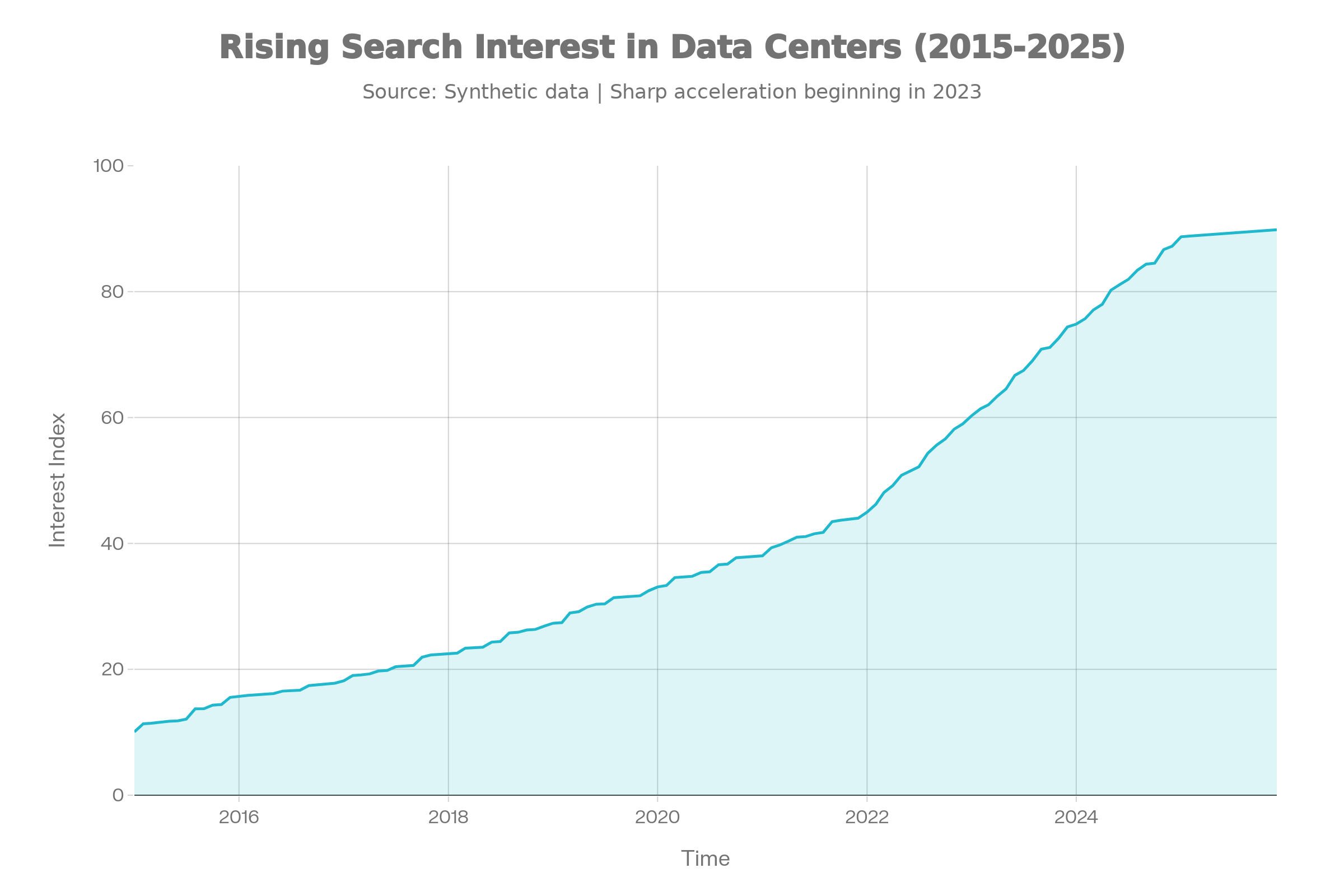
As build‑out exploded, so did the backlash: Concern over power prices, water use and mistrust of AI turned local communities against new projects, slowing or blocking sites across the US and popping up in Europe and elsewhere too.
In the US alone, a Data Center Watch report found that:
$64 billion in U.S. data center projects have been blocked or delayed by a growing wave of local, bipartisan opposition. What was once quiet infrastructure is now a national flashpoint — and communities are pushing back.
Of course, politicians were quick to join the fight, with key special elections being won on anti-data-center rhetoric and even a national moratorium suggested by one Bernie Sanders:

By year’s end, it was simply harder to get a data center approved in the US than almost anywhere else.
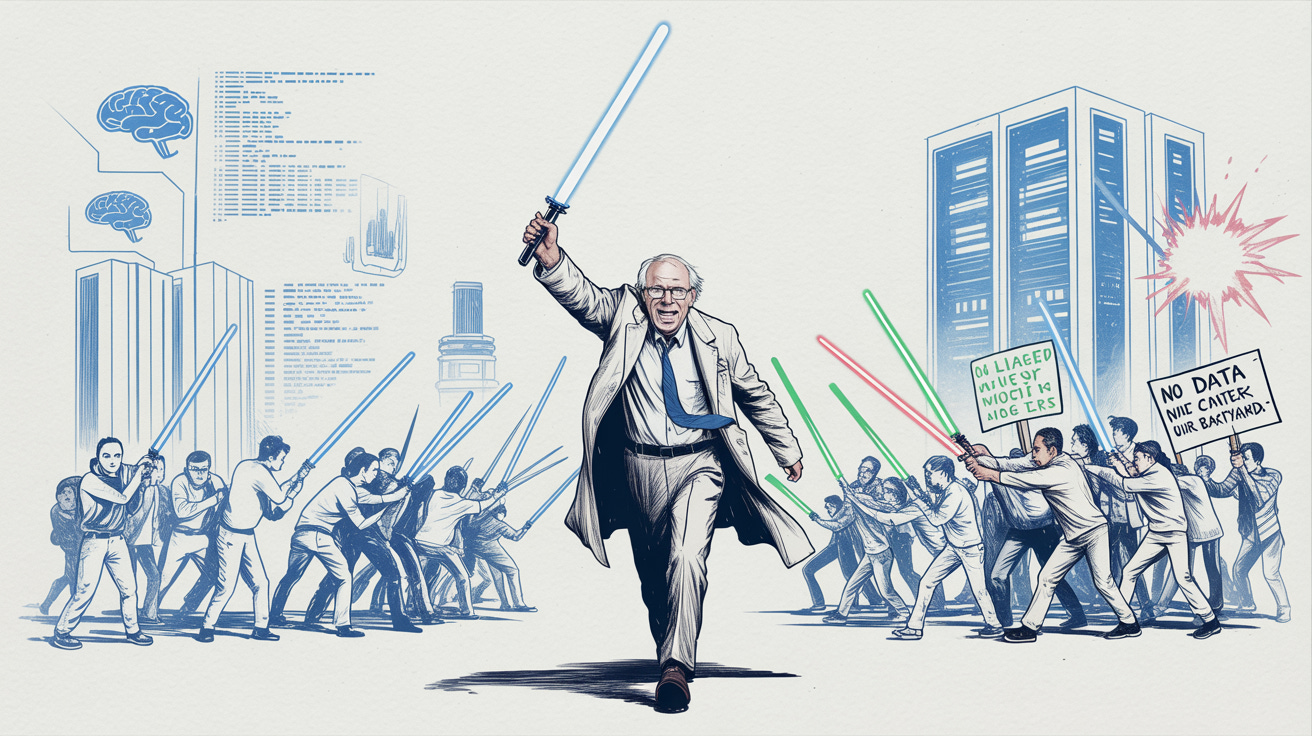
🔭In 2026, we will continue to see a version of the Data Center Wars, especially in national discourse.
That doesn’t mean that new data centers will not be built. I believe it’s more likely that at the local level, operators will learn to work with communities and adjust their plans to be at least somewhat compatible with community needs.
It’s likely that operators will become more sophisticated and effective with community outreach and dialogue. There’s just too much at stake for them not to take communities seriously.
Will communities learn to trust operators and developers? I guess we’ll see.
Europe’s Dilemmas and Climate Aspirations
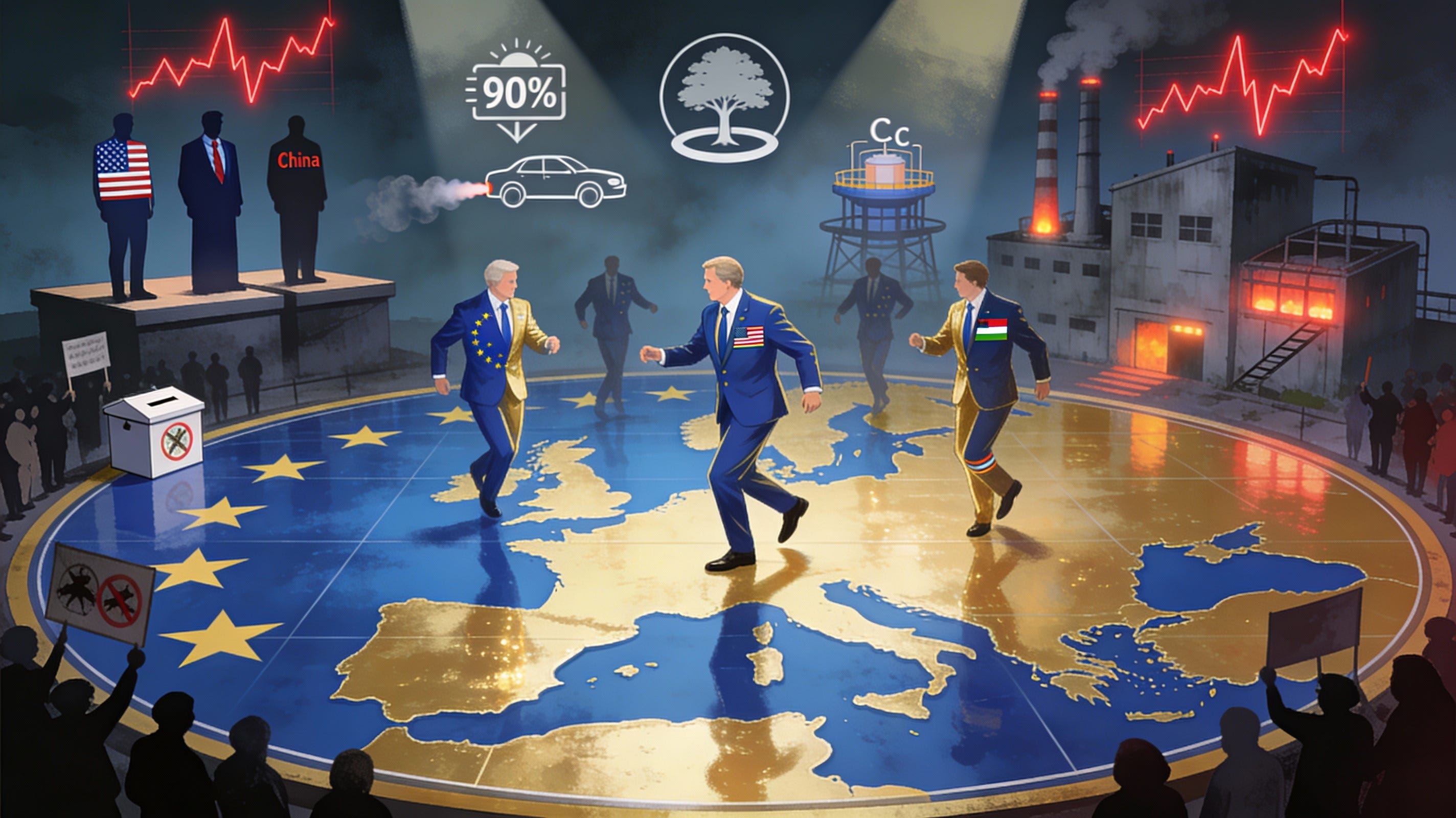
I spent a lot of time following Europe’s climate cha-cha.
The year started off strong, with the European Commission making headlines with its ambitious 90% reduction target by 2040.

But with mounting political, geopolitical, economic and social pressures, Europe started dancing to a strange tune: one step forward, half a step backwards.
Since then, Brussels has managed to water down key policies like the combustion‑engine phase‑out, delay implementation of the EU Deforestation Regulation and padded major texts with just enough ambiguity for future politicians to slip out of today’s promises, all while signing a suspicious number of feel‑good declarations.
Member states added their own chaos. From Sweden rolling back climate measures to countries balking at heat‑pump and air‑con rules, “Europe” looked less like a single climate project and more like 27 different domestic fights playing out under one banner.
Some of my coverage this year focused exactly on this:


At the same time, there were some good things. Norway, for example, did something great with Northern Lights:

In 2026, I think the EU will continue to walk a tightrope between climate ambitions and difficult realities, as it faces a growing set of dilemmas: Social unrest and the rise of the far right; A hostile US, an aggressive Russia and an assertive China waiting around the corner; Rising energy prices and industrial decay.
I’m sure Europe is serious about being the world’s climate leader. But the more pressing question is: can it?
We’ll find out as Europe dances 2026 away!
Looking Ahead to 2026
There are plenty more things I looked at this year, and many more topics that took part in the reconfiguration of our world. Most of them will likely persist in 2026, even if they might take new shapes.
Here are some things I will be paying close attention to (unless other things will keep me busy):
👉 India: A superpower in the making, India’s activities in the climate scene are still relatively minimal, but I suspect we will see more in 2026, as its renewable sector is growing and climate is a great arena for geopolitical flexing. I will be following Modi and his crew very, very closely.
👉 Insurance: 2025 was already a tumultuous year for insurance companies. Many, thanks to the growing intensity and frequency of climate disasters, are reducing coverage in riskier areas and others are exiting markets entirely. In 2026, we are likely to see more and more of them. I will be looking to see how the industry reconfigures and realigns to this new reality.
👉 Electrotech: The growing electrification of everything is giving rise to a new hard and soft tech stack. It would be interesting to see how the growing electrification of our daily lives and our industries will have significant impacts on supply chains, innovation and basically everything else. China will likely be a beneficiary of this as both an advanced Electrostate and an exporter of electrical equipment.
👉 ClimateTech and Industrial Rebuild: Even with headwinds and a Greenlash, climate tech moved from “tourism” to putting serious steel in the ground. As Europe, APAC and the US grope toward industrial policy 2.0, 2026 will offer plenty of chances for genuinely clean technologies to scale, or fail loudly trying.
Talk of the Town: The Recap Edition
End of Year is always a time full of recaps, so I collected my favorite ones:
✍️ Amanda van Dyke provided her recap and predictions of the Mineral sector.
✍️ Climate Capital recapped climate investments
🖇️ CTVC’s 2025 unwrapped
✍️ Celia Ford covered the funniest and worst takes on AI this year
Thanks for reading! If you enjoyed this edition, don’t forget to subscribe or share your thoughts. 🔽
See you next week!
This quote is attributed to Galileo, muttering it under his breath after being forced to recant his support for the heliocentric model of the solar system.
I am being cheeky, but you get the point
My favorites are: Jordan Schneider’s ChinaTalk and Yuval Weinreb’s X account
I’m so happy you’re doing this Arod! It’s one of my favorite things to read when I’m overwhelmed with information. You make it fun!