


👋 Welcome to A World Reconfigured - your guide to a world changed by climate, geopolitics and technology. I write about how climate change is creating a new world with new rules, and often cover topics like the ❄️Arctic, 🤷♂️Rare Earths and 💻Data Centers.
If you happened to receive this email from a friend, please consider subscribing. If you’re already a part of this community, I’d love it if you could recommend it to a friend.
My Unsolicited Take:
Hi everyone,
It is week three of Epic Fury / Roaring Lion / the Iran war. Everyone is focusing, with good reason, on the oil and gas supply shock and the impact it will have over the region, and the rest of the world.
I agree it’s a big issue, but looking ahead I’m more concerned about mineral shortages. While I’m trying to release a more methodical argument, the core idea is that wars tend to negatively impact mineral supplies and rapidly increase demand.
It’s not a bad thing, but it has major implications for geopolitics and everyone else. From raising prices for consumer electronics to giving China an extra edge, I suspect the war’s impacts will reverberate far longer and wider than we tend to think.
Elsewhere, lots of things are happening while we focus on the Iran War. Canada is going HAM in the Arctic, China continues its FYP process and Data Centers are still very unpopular in the US, threatening to be a bigger issue in the midterms than gasoline prices. And that’s just one week.
What can I say, 2026 is proving itself to be an even wackier year than 2025. How much worse can it get? Like Donald Trump likes to say: We’ll see what happens.
~Arod
TL;DR
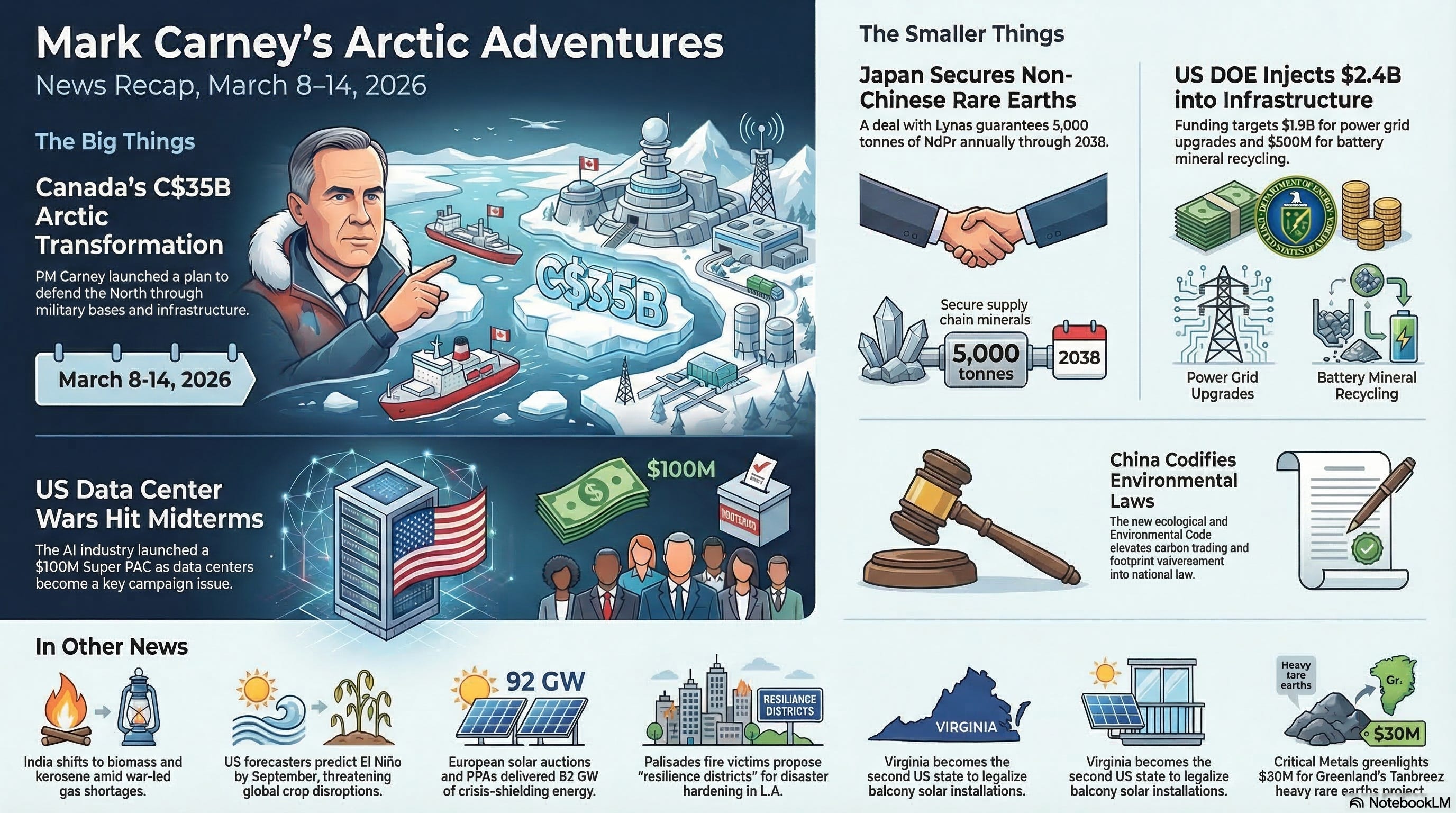
The Bigger Things
Mark Carney had a big week in the Arctic (he brought a $35B coat)
Data Centers are the defining issue of the midterms (well a lot of people hate them)
The Smaller Things
Japan signs a deal with Lynas to secure rare earth supplies after China threats (they never learn, do they)
China signs the Environmental Protection Code into law (but covers mountains in solar panels 🤷♂️)
US DOE wants to give you money for Grid upgrades and critical minerals (do they want to support my writing?)
In Other News: India goes back to fossil fuels, Critical Metals greenlights Tanbreez, Virginia legalizes balcony solar and more.
The Bigger Things
The biggest stories you probably missed:
Mark Carney’s Big Arctic Week
What Happened? Canadian PM Mark Carney was very busy this week:
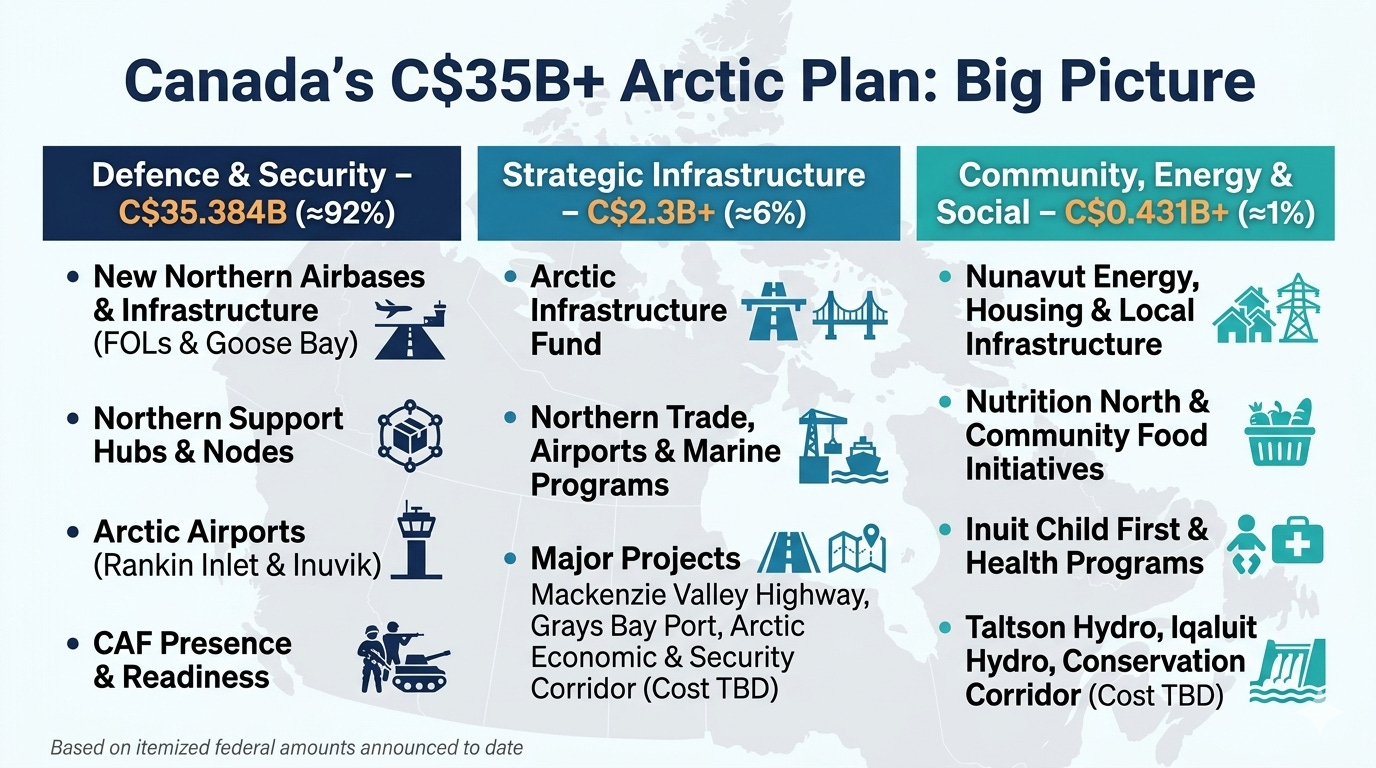
First, he announced a landmark ~C$35B plan to “defend, build, and transform the North”, which includes massive investments in military bases, infrastructure and even community projects to strengthen Canada’s position in the Arctic (and the broader Canadian North).
If that wasn’t enough, Carney traveled to Norway, to observe NATO’s Arctic military exercise, Cold Response. Later, Carney traveled to meet with leaders of the Northern countries. Carney did mostly watching and talking, but he did give a killer speech:
Why Care? 🤷♂️ Because Carney is on a journey to transform Canada into an Arctic superpower (and a general Middle Power). True to his Middle Powers speech in Davos last year, Carney is focused on positioning Canada as a leader in the Arctic, a topic that is becoming top of mind for many countries. Some of this is, of course, performative, since it’s not clear how much Canada is actually contributing to Cold Response1. Oh well, we do live in a Social Media world.
My Take: ✍️ I generally like Carney and I like Canada. I think it’s a net good having Canada playing an outsized role in the Arctic, as long as it does so without ignoring the native communities. We’ll see what happens.
Oh also, I made an AI-generated breakdown of the Arctic plan, just for you:
Data Centers Wars: It’s All Politics (and Prices)
What Happened? In the latest installment of your favorite TV show “The Data Center Wars”, it became pretty clear this week that DCs are now a major part of the political landscape in the US.
Heatmap News did a fantastic job at highlighting just how DCs are playing a major role in shaping US politics ahead of the midterms, pushing even Republicans to take a stand against them.
The AI industry is pushing back, of course, with a new $100M super PAC that is currently targeting Marjorie Taylor Greene, who has been very vocal against data centers.
Why Care? 🤷♂️ Because data centers are quickly becoming a key operative issue of the midterms, with the AI industry standing on one side and a lot of angry people on the other. You might be tempted to think it’s gas prices, but the upcoming midterms will likely focus on AI, Data Centers and, well, permitting and stuff.
My Take: ✍️ Yeah I’m staying out of this one.
The Smaller Things
The stories you should have on your radar:
Japan Gives China the Rare Earth Finger
What Happened: Japan amended its deal with Australia's Lynas Rare Earths to extend it through 2038 and include improved terms. The deal guarantees Japan 5,000 tonnes of light rare earths (NdPr) annually with a price floor of $110 per kilogram (similar to the price of MP Materials’ price floor). Additionally, Lynas will reserve 75% of its highly prized heavy rare earths specifically for the Japanese market.
Why Care? 🤷♂️ Because this deal is a part of Japan’s series moves to break free from China’s rare earths chokepoint. Just a few months ago Japan decided to embark on an experiment to deep sea mine rare earths:

This latest deal comes shortly after China threatened to place export controls over rare earths in retaliation for PM Takaichi’s remarks on Taiwan. Japan took the threats seriously, so it seems, and is working to create alternative supply chains.
My Take: ✍️ Instead of putting Japan in its so-called place, China’s threats galvanized the Takaichi government to find alternatives. It seems like China doesn’t want to learn the Oct 2025 lesson. Oh well.
China Signs Landmark Climate Legislation
What Happened: A week after Beijing received major flak for meh climate commitments in its 15th Five-Year-Plan, China adopted the Ecological and Environmental Code. The code consolidates dozens of fragmented rules into one sweeping legal framework. It officially elevates tools like carbon emissions trading and footprint management into national law.
Why Care? 🤷♂️ Because despite the criticism and underwhelming climate targets, China still appears to be taking environmental regulation seriously and trying to keep decarbonizing. Given China’s scale and size, this move will have visible impacts.
My Take: ✍️ Not sure how this new piece of legislation goes hand in hand with solar‑panel‑covered mountains:


US DOE Wants to Give You Money
What Happened: US Dept. of Energy announced two major funding packages this week: $1.9 billion to rapidly upgrade the U.S. power grid using advanced, higher-capacity wires, and $500 million to boost domestic processing and recycling of critical battery minerals.
Why Care? 🤷♂️ Because the US is finally getting serious in promoting innovation and technology in its quest to modernize its infrastructure, and continues the push towards mineral independence. With respect to the Grid, the US is due for an upgrade of its aging electrical grid, and it’s about time we’ve seen a major funding opportunity.
My Take: ✍️ Mom always told me I should become a Reconductor. But noooo, I always know better 😤
In Other News:
📰 📰 India turns to polluting fuels like biomass, kerosene, and fuel oil amid war-led gas shortages (e tu, Modi?)
📰 US forecasters predict El Niño by September, threatening higher global temperatures and crop disruptions. (I guess this is the real comeback kid)
📰 Solar auctions & PPAs delivered 92 GW shielding Europe post-2022 crisis (and you thought renewables are bad…)
📰 Palisades fire victims propose resilience district for disaster hardening amid L.A. housing hurdles (big if successful)
📰 Virginia legalizes balcony solar, second after Utah (pack your bags, we’re going to VA!)
📰 Critical Metals greenlights a $30M push to fast‑track its Tanbreez heavy rare earths project in Greenland toward late‑decade production as Western allies seek non‑Chinese supply (oh hey, at least somebody is doing something about it)
Thanks for reading! If you enjoyed this edition, don’t forget to subscribe or share your thoughts. 🔽
See you next week!
Canadian security expert Wesley Wark makes a great note about the question of just how committed Carney is in practice to Arctic security, with little details available as to Canada’s actual contribution to Cold Response and to Arctic Sentry. Oh well.