


👋 Welcome to A World Reconfigured - your guide to a world changed by climate, geopolitics and technology. I write about how climate change is creating a new world with new rules, and often cover topics like the ❄️Arctic, 🤷♂️Rare Earths and 💻Data Centers.
If you happened to receive this email from a friend, please consider subscribing. If you’re already a part of this community, I’d love it if you could recommend it to a friend.
TL;DR
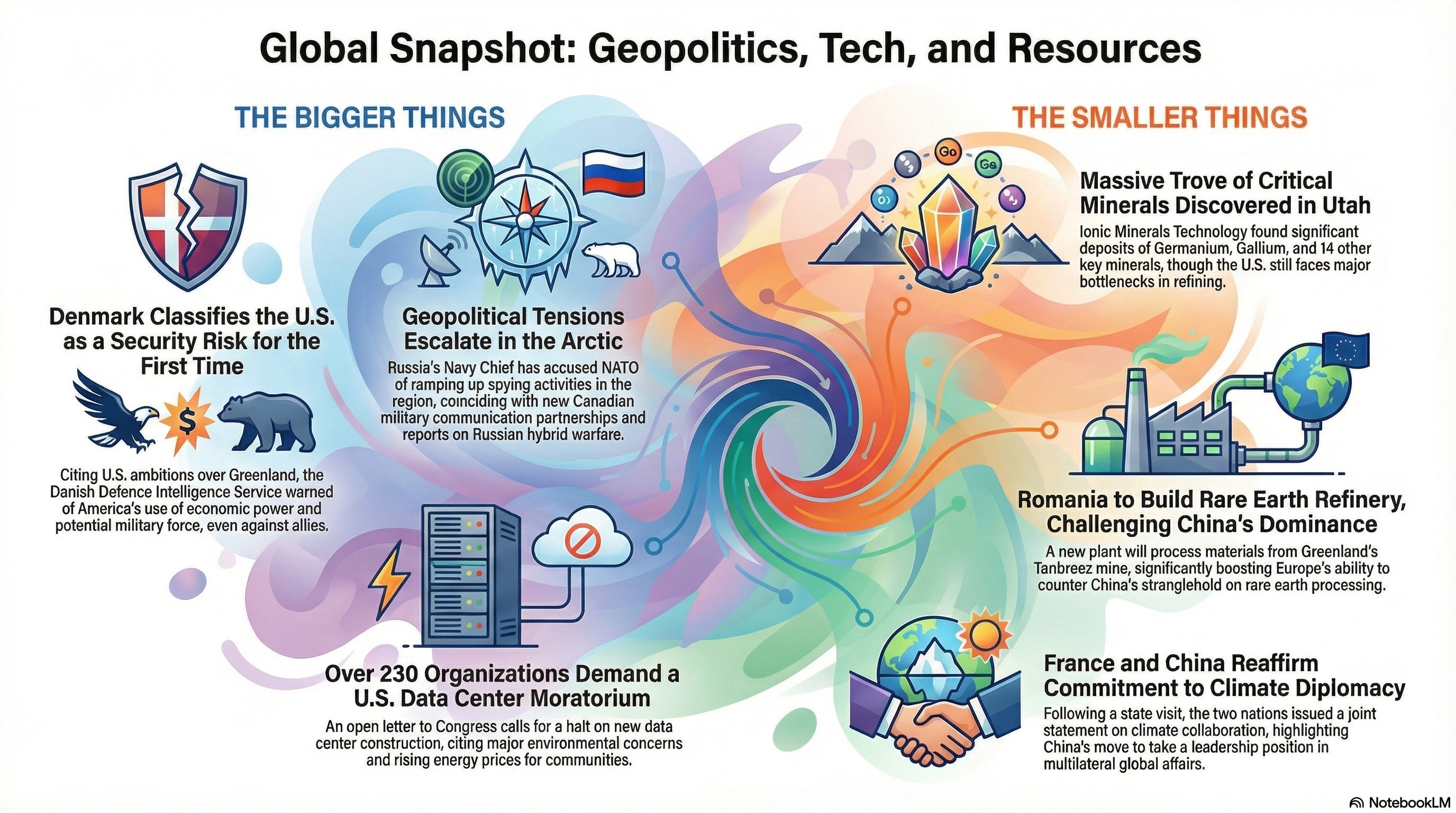
The Bigger Things
Denmark goes HAM on the US (Oh hey Denmark, you finally noticed Trump wants Greenland)
More trouble is brewing in the Arctic (quick, someone call Pierce Brosnan out of retirement)
While new AI preemption EO is published, orgs call for a data center moratorium (can we have an epic lightsaber battle to decide?)
The Smaller Things
Trove of new critical minerals discovered in Utah (but it’s not going to help a lot in unseating China)
Romania to build a Rare Earth refinery (now, this is the way to counter China)
China and France reaffirm commitment to climate diplomacy and multilateralism (China is now the prom chaperone)
The Talk of the Town
Cement-pooping bacteria, US NSS on Minerals, Arctic Sea-Salt, 2025 recapped for Chinese AI and more!
The Bigger Things
The biggest stories you probably missed:
Denmark goes HAM on the US
What Happened? This week, Denmark’s Defence Intelligence Service (DDIS) labeled the US a security risk for the first time, citing Washington’s ambitions in Greenland. The report points to the new US National Security Strategy, warning that Washington uses economic pressure and even the threat of force, including against allies.
I dug into this story before:

Why Care? 🤷♂️ Because the US’s ambitions to take over Greenland are a part of the broader geopolitical realignment. Danish warnings come at the same time as Greenland refuses to let Starlink enter the country, citing concerns over Musk’s ties to the Administration. And let’s not even get started with Russia and China...
My Take: ✍️ The US tried to calm things down, but the Arctic is experiencing a seismic shift. Honestly, this is starting to look like a Mexican Standoff. To quote Key and Peele’s epic skit: “Who’s double-crossing themselves while dressed as each other”.
More Troubles in the Arctic
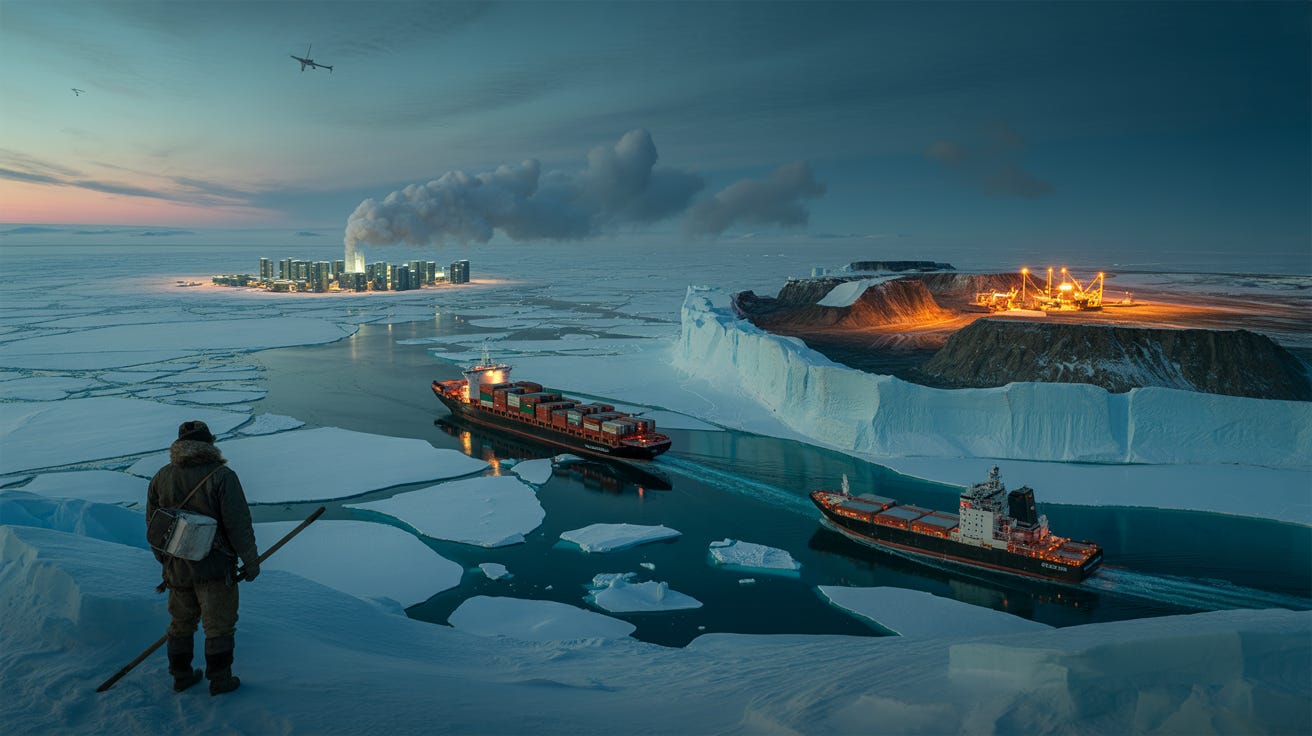
What Happened? As if the US-Denmark rift wasn’t enough, the Arctic had another banner week for bad news. Russia’s navy chief accused NATO of stepping up spying in the region, just as Canada rolled out a new partnership to close its Arctic military communications gap. At the same time, a new report details Russia’s hybrid warfare tactics on Svalbard since 2014, and experts warn that the Ambler road approved by the Trump Administration could push Alaska’s Arctic to the brink.
Why Care? 🤷♂️ Because the pace of events in the Arctic is picking up, from climate degradation to geopolitical tensions. It’s hard at this point to say anything with certainty, but it does seem like the Arctic is gearing for something bigger.
My Take: ✍️ Are we on the way to the Second South China Sea in the Arctic? Maybe I’ll post some thoughts about this soon!
Calls for US Data Center Moratorium
What Happened? While everyone is talking about the AI Preemption Executive Order that somewhat preempts state AI regulation1, a new kind of moratorium is gaining steam in the US, one diametrically opposed to the Trump Administration’s policy: Stop building data centers.
Over 230 organizations have sent an open letter to Congress, asking it to take action and forbid the construction of new data centers, citing environmental concerns and rising energy prices.
Why Care? 🤷♂️ Because these movements tends to have lives of their own. It’s easy to dismiss them as a bunch of hippies, but with NIMBY already reshaping data center buildout in the US, this moratorium call might travel further than people expect. Congress is unlikely to act, but the pressure on local politicians, developers and even Hyperscalers is real.
My Take: ✍️ Are we seeing the tides turning against Data Centers, or will the Trump Administration prevail? Only one way to decide: Lightsaber Duel.

The Smaller Things
The stories you should have on your radar:
Lots of New Minerals for the US
What Happened: Ionic Minerals Technology, a US critical minerals company, has uncovered a gargantuan deposit at its Silicon Ridge mine in Utah, containing germanium, gallium and 14 other critical materials used in advanced technologies. Some countries have all the luck, I guess.

Why Care? 🤷♂️ Because in the race for mineral security, every new domestic source helps. This find gives Washington more room to build out alternative supply chains and chip away at its dependence on China.
My Take: ✍️ Yeah, this is great and stuff, but the real bottleneck lies in refining, separation and product integration. The US remains heavily reliant on China, and this new deposit won’t radically change the strategic dependency unless refining capacity scales up at home or with trusted partners.
Romania Joins the Rare Earth Gang
What Happened: Speaking of breaking China’s grip on critical minerals, here’s something that will actually move the needle: Critical Metals has announced a JV with Romania’s FPCU to build a rare earth processing plant in Romania. The facility will handle up to 50% of the output from the Tanbreez mine in Greenland.

Why Care? 🤷♂️ Because unlike mining, refining is the real chokehold. This refinery does help ameliorate the West’s refining soft spot. This deal follows MP Materials’ JV with Maaden to build a refinery in Saudi Arabia, putting Europe on the map with respect to the ability to counter China’s stranglehold over rare earth processing.
My Take: ✍️ We’re literally witnessing the reconfiguration of rare earths in the making, one deal after another. Exciting times ahead. My bet is China is looking closely and looking for ways to strengthen its position, while more deals are likely to follow.
France and China Collaborate on Climate
What Happened: During a state visit to China, French President Macron and Chinese President Xi issued a joint statement pledging deeper cooperation on climate change and environmental challenges, and voicing renewed support for multilateral climate institutions and processes such as the IPCC.
Why Care? 🤷♂️ Because while the US turned away from both climate action and multilateralism, China is stepping into the void and is taking a leadership position on global affairs, with climate change being a key priority for Beijing.
My Take: ✍️ Nature abhors a vacuum, and this is no exception. Beijing has consistently used US strategic retrenchment to cast itself as the engine of the very multilateral order it once resisted, and climate diplomacy is a particularly convenient arena given China’s ability to scale climate tech and energy capacity at astonishing speed.
Talk of the Town:
I read way too much Linkedin, Twitter and Substack for my own good. Here are a few of my favorites this week:
✍️ Amanda van Dyke provides a mineral-focused analysis of the US National Security Strategy and explores the ESG aspects of mining.
✍️ Matthew Jensen shares the news about cement-pooping bacteria and cosmic candy (I still can’t believe it’s real!)
✍️ Michael Thomas shares his report and takeaways on Data Centers and NIMBYism
🔗 Matthew Henry shares a new study on marine cloud brightening in the Arctic, showing that sea-salt particles can help restore Arctic sea ice
✍️ Global Data Center Hub explores the rise of sovereign clouds and the shifts in the investment landscape that are taking place
✍️ Irene Zhang of ChinaTalk recaps Chinese AI’s 2025, looking at robotics, policy and US-China competition. Extra recommended to those who want to understand the big picture of AI and China
Thanks for reading! If you enjoyed this edition, don’t forget to subscribe or share your thoughts. 🔽
See you next week!
This is of course a complex topic, but in short, the EO cannot fully implement preemption, therefore it calls upon Congress to legislate on the matter. Meanwhile, the EO establishes several mechanisms to deal with the existing landscape, including establishing a taskforce to litigate state laws and directs agencies to remove red tape.