


👋 Welcome to A World Reconfigured - your guide to a world changed by climate, geopolitics and technology. I write about how climate change is creating a new world with new rules, and often cover topics like the ❄️Arctic, 🤷♂️Rare Earths and 💻Data Centers.
If you happened to receive this email from a friend, please consider subscribing. If you’re already a part of this community, I’d love it if you could recommend it to a friend.
TL;DR
The Bigger Things
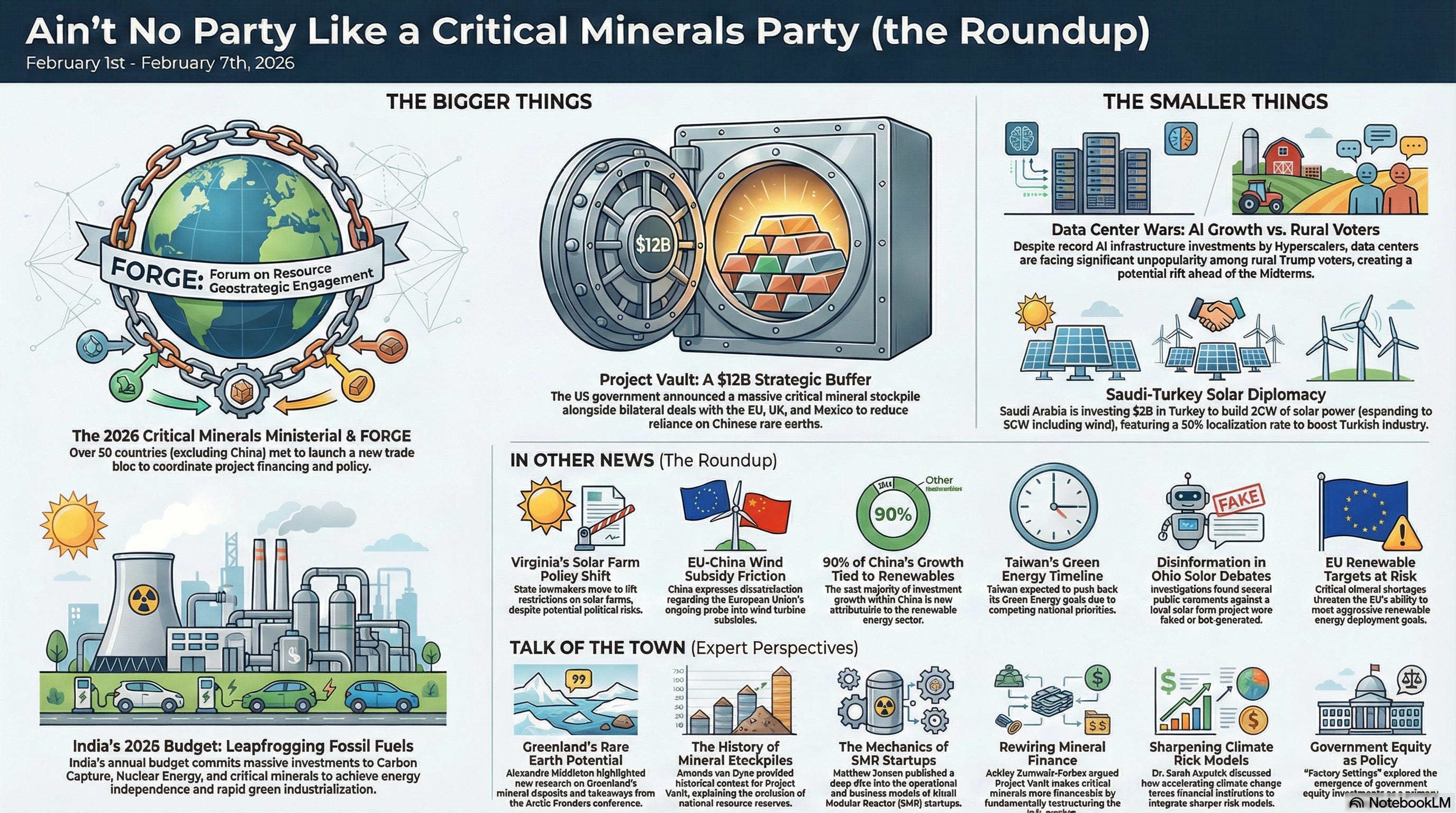
2026 Critical Minerals Ministerial takes place with over 50 countries (but China wasn’t invited… maybe that was the point)
India’s 2026 budget holds big promises for decarbonization and the green transition (I’m waiting for a Bollywood movie about solar panels)
The Smaller Things
Data centers are at odds with Trump voters (we’ll see what happens)
Saudi Arabia and Turkey demonstrate solar diplomacy (peace in the middle east… through solar panels?)
In Other News: Lots of stuff
The Talk of the Town
Critical minerals, government equity investments 101, history of mineral stockpiles and so much more
The Bigger Things
The biggest stories you probably missed:
Critical Minerals FORGE Ahead
What Happened? Over 50 countries attended the US’s 2026 Critical Minerals Ministerial, which is the mineral version of Woodstock or something. During the event, the US announced “Forum on Resource Geostrategic Engagement” (FORGE), which serves as a trade bloc with preferential terms that will help coordinate projects and policy.
The US government also announced project Vault, a $12B critical mineral stockpile and signed a flurry of bilateral deals, MoUs and frameworks with Mexico, EU, UK and others.
Why Care? 🤷♂️ Because this is a culmination of the US’s attempt to break free from China’s stranglehold over critical minerals and rare earths, a dependence that is still growing. These moves stirred overall positive responses, though not without critique.
My Take: ✍️ Called it! I published a piece on the US strategy, where I claimed that multilateralism (or plurilateralism) is one of the Administrations key strategic levers. This week, they definitely upped the ante on this one:

India’s New Budget and Renewables
What Happened? India released its annual budget last week. The budget is complex and signals the direction which India is going to, which is rapid industrialization, focus on advanced defense and tech capabilities, and more (I thank Dr. Lauren Dagan Amos for her insights on the budget).
Interestingly, the budget includes massive investments in Carbon Capture, Nuclear Energy infrastructure, renewables, adaptation and critical minerals and rare earths.
Why Care? 🤷♂️ Because India’s push for rapid industrialization and growth includes pivotal moves towards decarbonization, energy independence through renewables and catch up on critical minerals. This budget meets India’s ambitions to be a global power, but one that leapfrogs fossil-fuel growth.
My Take: ✍️ We are going to hear a lot about India’s push towards decarbonization and mineral independence. I think India is going to be a big part of the 2026 geopolitical and energy map.
The Smaller Things
The stories you should have on your radar:
Data Center Wars: Trump Voters Don’t Like Them
What Happened: As Hyperscalers issue guidance this week on record AI infrastructure investments, a recent HeatmapNews article shows how unpopular data centers are among… Trump voters, primarily in rural areas. This sentiment joins general unpopularity of DCs
Why Care? 🤷♂️ Because the unprecedented support given by the Trump Administration to Data Center development is starting to seem like it is diametrically opposed to the preferences of the MAGA base, which can cause a rift between Republicans and their voters ahead of the Midterms Elections.
My Take: ✍️Well, what can I say. As the President likes to say: We’ll see what happens.
Saudi Arabia and Turkey Signed a Solar Deal
What Happened: Saudi Arabia agreed to invest $2B to build solar power plants in Turkey, as part of a bigger deal between the two countries to scale renewable energy to the tune of 2GW of solar, and then later additional 3GW of wind. This agreement will include 50% localization rate, which will help boost local Turkish industry.
Why Care? 🤷♂️ Because this is a good example of the global push towards renewables AND is a sign of how the Middle East is reconfiguring at the geopolitical level. Saudi Arabia and Turkey are starting to collaborate more, and energy is one key channel to realignment.
My Take: ✍️ We are likely to see more of these announcements, and I will not be surprised if we see Saudi Arabia playing the role of renewable developer writ-large in the Middle East, and perhaps in other regions, as the Saudi Kingdom attempts to diversify its economy and project soft power in the region.
In Other News:
📰 Virginia Lawmakers want to un-restrict solar farms (good luck in the midterms!)
📰 China is not happy about the EU’s probe over Wind subsidies (no one ever liked a probe I guess)
📰 Speaking of China, 90% of its investment growth is attributable to renewables (yeah I have nothing witty to say here)
📰 Taiwan is likely to push timeline to meet Green Energy goals (don’t they have bigger fish to fry?)
📰 Some comments against a solar farm in Ohio are fake (I guess we trained Moltbook to be anti-solar?)
📰 EU renewable push is at risk thanks to critical mineral shortages (look surprised!)
Talk of the Town:
I read way too much Linkedin, Twitter and Substack for my own good. Here are a few of my favorites this week:
🖇️ Alexandra Middleton share many insights: Published a paper on Greenland’s Rare Earths and provided a recap of the Arctic Frontiers conference. I’d love to go next year!
✍️ Amanda van Dyke shared a historical perspective on stockpiles, in light of the launch of Vault.
✍️ Matthew Jensen masterfully unpacked how SMR startups work
🖇️ Ashley Zumwalt-Forbes showed how Project Vault makes critical minerals financeable by rewiring U.S. market structure.
✍️ Volts hosted Dr. Sarah Kapnick about how climate change is speeding up, models are getting sharper, and rising risks now touch everything from daily weather to money decisions
✍️ Factory Settings explored how government equity investing is emerging as a pivotal new policy tool rather than a niche financial experiment
Thanks for reading! If you enjoyed this edition, don’t forget to subscribe or share your thoughts. 🔽
See you next week!