


👋 Welcome to A World Reconfigured - your guide to a world changed by climate, geopolitics and technology. I write about how climate change is creating a new world with new rules, and often cover topics like the ❄️Arctic, 🤷♂️Rare Earths and 💻Data Centers.
If you happened to receive this email from a friend, please consider subscribing. If you’re already a part of this community, I’d love it if you could recommend it to a friend.
My Unsolicited Take
Lots happened while I was (kinda) away
Well, I was away for a while, busy with life and other things.
I’ve also been doing a lot of public speaking on minerals over the past few weeks, mostly engaging entrepreneurs and investors in our local ecosystem, trying to convey what I see on the world stage, and what innovators should do with it. I’ll share more in the coming weeks as I finish a few other stage related obligations. In the meantime, here’s me at a panel on Critical Minerals during Energy Tech Week:

While I was away, a lot happened: The minerals race is heating up; the Arctic continued to militarize and private markets are still trying to figure out what to do about SpaceX.
Like always, I tried to give you a taste of some of the interesting things I’m seeing out there on a few tracks I’m following.
And while I was away, I’ve been thinking on how to improve my coverage and this Substack to make sure you all keep getting the best I can give you. Stay tuned for more!
~Arod
TL;DR
The Bigger Things
The minerals race is getting much hotter (should I bring sunblock)
Data Center Wars: Texas governor announces directive against data centers (things are that bad huh)
The Smaller Things
Clean energy had another great week (I should consider opening a PV factory, too!)
UK wants to build a climate time machine (can they build a political one too?)
In Other News: PJM congestions, Chinese electric trucks and so much more
The Bigger Things
The biggest stories you probably missed:
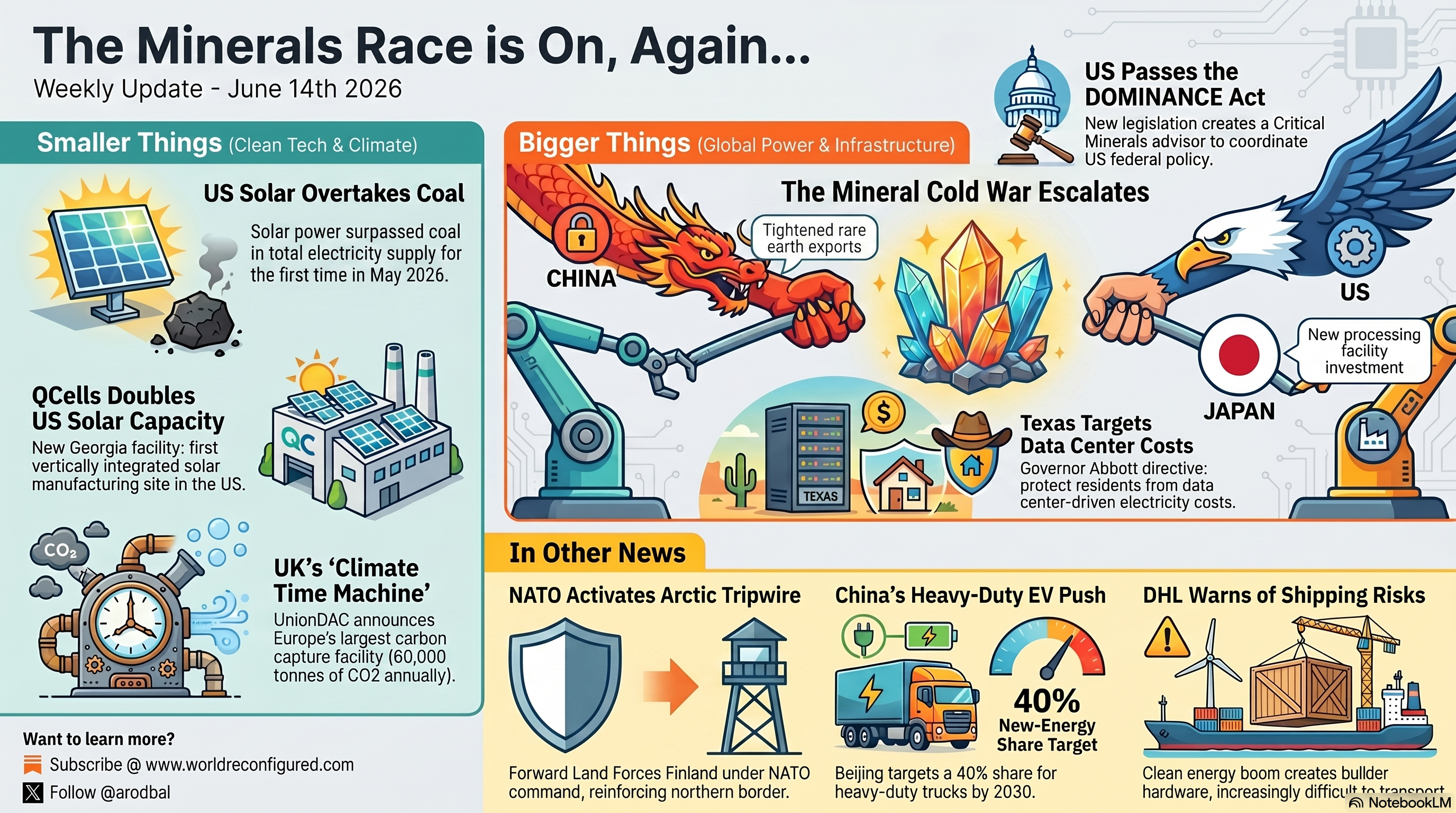
The International Race for Minerals Heats Up Again
What Happened? Ugh, the international race for minerals is heating up again.
After the long awaited Trump-Xi summit that amounted for very little on the minerals front, trouble is brewing over the horizon:
Despite the Trump Administration’s ask, China reaffirmed rare earth export controls and limits for Japan
Japan kind-of knew it was coming, and decided to invest in a brand new processing facility
The US has added a bunch of Chinese firms (BYD, CATL and others) to its naughty list, which has nothing to do with minerals per se, but will likely result in a rare earth response by China
China created more stringent enforcement protocols for rare earths, putting the screws on suppliers so they will not dare defy Beijing’s export control
Indonesia, in a rare show of regulatory force, has seized 390 tonnes of rare earths that were shipped to an unknown destination. While this sounds like a fight against smuggling, Indonesia’s history suggests Jakarta is sending a signal: We can.
Finally, the US House of Representatives has passed this week the DOMINANCE ACT, which sets to coordinate US policy, create a special Critical Minerals advisor to the President and more. Luckily for you NotebookLM spells out the major provisions:

It was only a matter of time until Congress stepped into the Critical Minerals race, but the new provision, if it were to become law, will provide much needed coordination in the Federal government, but won’t actually change the landscape. Still, it’s a welcome development.
Why Care? 🤷♂️ Because the minerals race isn’t going anywhere, whether or not the Busan Agreement will be extended or not. It is quite evident that Critical Minerals are the new weapon of the decade, used by China as a way to exert power on the global stage, and the focus of coordinated action by Western, LATAM and ASEAN countries.
Over the next several years, we should expect that Critical Minerals will be a fixed feature of industrial, international and innovation policy in the US, the EU and other major countries.
My Take: ✍️ I would look at how this heating race affects the mineral majors and how middle powers like Canada, Brazil and Australia will leverage the need to diversify to their own posture.
My bet, though, is on Japan. Japan has shown it gets to work and fast with a host of moves in response to China’s ban, including a JV with Lynas, its famous Deep-Sea experiment and now the new processing plant. Japan is really heads down working.

Data Center Wars: Et Tu, Texas?
What Happened? Just how unpopular Data Centers are in the US, you ask? So much so that Texas (!) Governor Gregg Abbott issued a directive to state agencies to protect consumers from Data Center-related costs:
“Texas has enjoyed extraordinary economic success that has spurred unprecedented job growth and attracted more businesses than any other state. Due to Texas’ success, it has become a magnet for business development, including data centers. The rapid scale of data center development requires oversight to ensure everyday Texans are not burdened with the costs of infrastructure driven by data center expansion, and to ensure that as data centers interconnect to the Electric Reliability Council of Texas (ERCOT) grid, residential electric bills are not negatively affected.”
The directive aims at reducing electrical bills, ensuring Data Centers pay their way to infrastructure upgrades, ensuring water usage efficiency, repealing excess incentives and more.
Why Care? 🤷♂️ Because Texas is bellwether for how bad things are for Data Centers in the US. Texas is not particularly known for its regulatory burden, and yet Governor Abbott’s letter shows just the opposite.
On second thought, it shouldn’t be a surprise. Despite the Trump Administration’s overwhelming support of Data Centers and AI, Data Center buildout is an easy political target due to just how unpopular they are in the US (I recommend Heatmap News’s excellent coverage). Politicians across the political spectrum are weighing in on Data Centers, and mostly not in their favor.
My Take: ✍️ I expect this situation to persist. The debate is complex, and I am not an energy, water or compute expert. But I don’t think it matters. It’s not about whether Data Centers cause issues, rather that the American public thinks they do. With the Midterms just around the corner, I expect this topic to continue to bubble up and reshape both local and federal elections.
The Smaller Things
The stories you should have on your radar:
Clean energy had another great week
What Happened: Clean energy had another good week in general:
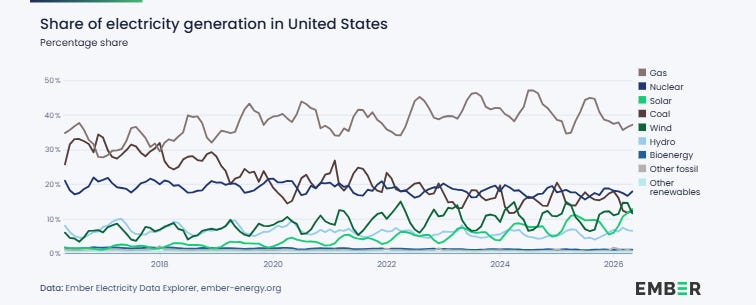
New report shows that Solar passed Coal in total electricity supplied in the US for the first time in May 2026:
QCells opened its new solar panel manufacturing facility in Georgia, effectively doubling the US’s industrial capacity when it comes to PVs. This is the US’s first and only vertically integrated facility for solar panels.
The Trump Administration dropped its appeal of a court decision overturning a permitting freeze announced in an EO on Trumpo’s first day in office, bringing Wind Energy back. Well, kind of.
Why Care? 🤷♂️ Because despite the current Administration’s best efforts, clean energy in the US is still a thing, and continues to be a thing. Each news is a bit different in scope and importance, but all lead to the conclusion that there’s much momentum, still, behind clean energy in the US, from Geothermal to Solar to Wind.

My Take: ✍️ The QCells announcement is worth a second look: This is not about energy capacity, but rather manufacturing capacity. China is the undisputed leader in PV manufacturing, effectively dominating 80% of the supply chain. Expected to double industrial capacity, the new QCells site may not break China’s hold over PVs, but it will give a good fight, with 3.3GW of capacity across the Ingots, Wafers, Modules and Cells.
Europe should be particularly interested, given its attempts to resist the Second China Shock, and PVs are a big part of those.
The UK wants to build Europe’s biggest climate time machine
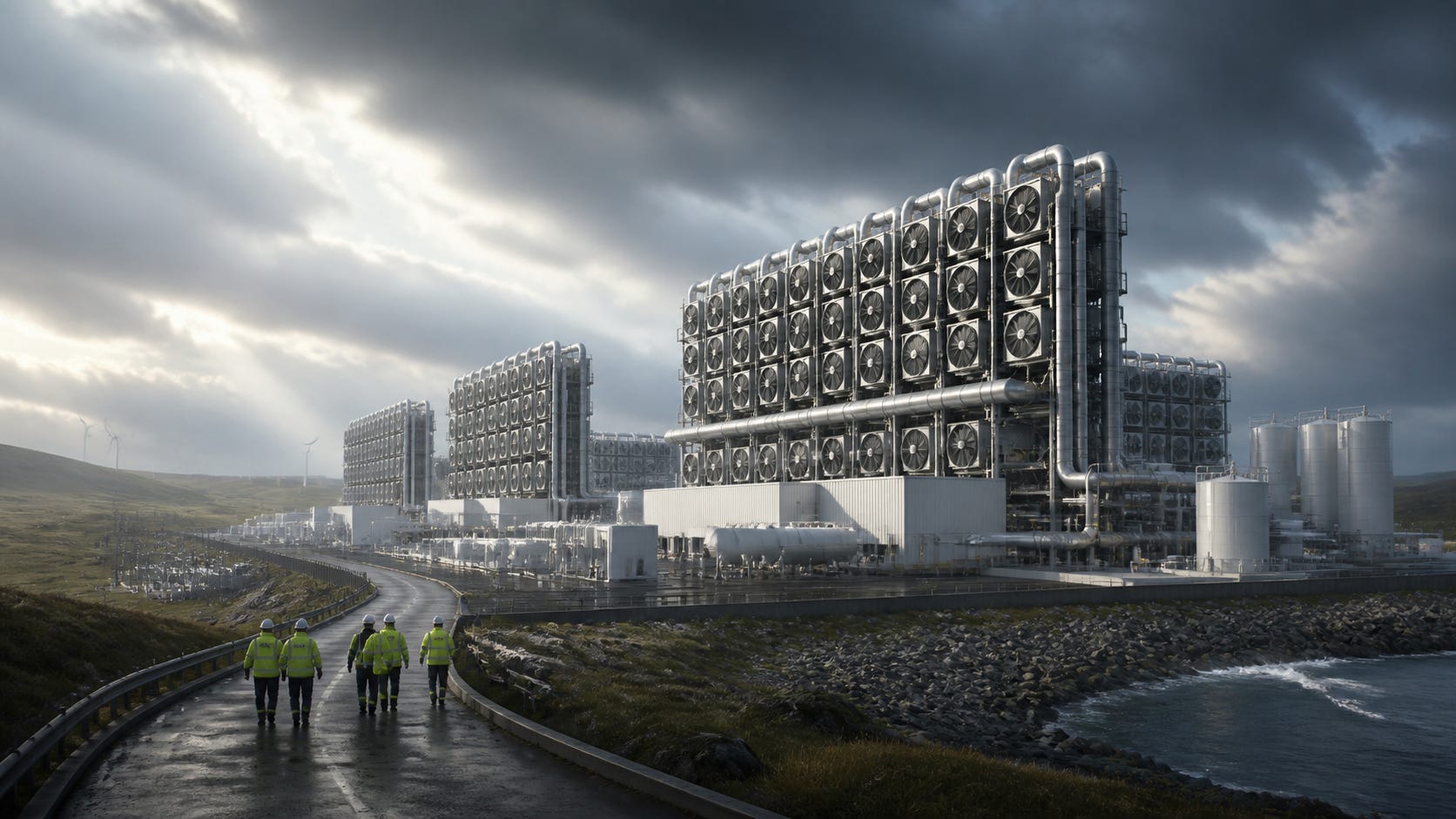
What Happened: A new partnership by several UK-based companies, called UnionDAC, has announced intentions to build a new, gargantuan facility that will serve as Europe’s largest Direct Air Capture facility, dwarfing others. The new facility will suck 60,000 tonnes of CO2 annually from the ambient air by 2032. DAC is often dubbed a climate time machine given its theoretical ability to “turn back time” when it comes to emissions.
Why Care? 🤷♂️ Because if successful, it will be a great demonstration that DAC works at scale, and is an affirmation of the Labor government’s commitment to scaling climate technologies (even though it’s not very popular these days).
On its own, the plant will not solve the UK’s Net Zero target problems,1 but it can help pave the way for additional facilities. Still, DAC has many critics, with some commentators calling it Greenwashing or a distraction from “real” solutions.
My Take: ✍️ The real threat to UnionDAC and the UK’s Net Zero ambitions is politics, as usual. With ReformUK’s recent wins, policies they oppose might get the boot, and as you may guess, RUK is not a big fan of climate policies. Can UnionDAC survive UK politics? I guess we’ll have to see.
In Other News:
📰 NATO activates Forward Land Forces Finland in Lapland, putting a Swedish‑led Arctic battlegroup under NATO command to reinforce Finland’s north as Moscow rebuilds its Leningrad MD and adds divisions in Karelia and Pechenga (Arctic tripwire is now live)
📰 Schneider Electric and Torngat Metals sign a Strange Lake‑anchored rare earths MoU, tying Nunavik mine, Labrador infra and Sept‑Îles separation into a G7‑blessed route to non‑Chinese heavy magnet REE (should I bring Thor?)
📰 DHL warns the clean energy boom is creating bulkier, riskier hardware that’s harder to ship at scale as it targets €3B in new-energy logistics revenue by 2030 (I have a spare truck if you want it)
📰 EDF flags possible nuclear output cuts at Saint-Alban as Rhone river heat threatens summer power supplies (I guess it’s not a good time for a swim?)
📰 China targets 40% new‑energy heavy‑duty truck share by 2030 with 1.6m‑plus vehicles and >80% electrification on key short‑haul routes (yeah about that truck…)
📰 Gridraven pegs PJM’s May 2026 congestion at $1 billion, warning that software‑based dynamic line ratings could have slashed costs on key 230 kV bottlenecks as data‑center load and heatwave‑driven demand surge (Good time to mention I have a few more Data Centers I want to build?)
Thanks for reading! If you enjoyed this edition, don’t forget to subscribe or share your thoughts. 🔽
See you next week!
To be fair, 60,000 tonnes is not a lot. The UK emits today 370-385 million tonnes of CO2 equivalent annually, making UnionDAC able to suck 0.016% of today’s emissions. That’s… not a lot.