


👋 Welcome to A World Reconfigured - your guide to a world changed by climate, geopolitics and technology. I write about how climate change is creating a new world with new rules, and often cover topics like the ❄️Arctic, 🤷♂️Rare Earths and 💻Data Centers.
If you happened to receive this email from a friend, please consider subscribing. If you’re already a part of this community, I’d love it if you could recommend it to a friend.
My Unsolicited Take:
Hi everyone,
My (beautiful) wife tells me that she always thought she’d be a student of history, not a participant. And yet, these past couple of years have felt like we’ve been active participants as history is being written.
There’s an adage I keep coming back to: There are decades where nothing happens; and there are weeks where decades happen.
These past few weeks (and even months) have felt like decades, and not only thanks to the Strait of Hormuz everyone is talking about. Yes, the Strait is the main show in town, and you probably are right in following it.
However, there are other shows around the world that make decades happen, even if they are less flashy than drones and ships. They are quieter, but warrant our attention.
From Pakistan to Denmark, there are signals that our world is changing, and quite rapidly. This past week, for example, critical minerals were the subject of geopolitical realignment, while the Danish election may determine the direction of the Arctic. Even the Strait had less visible, yet important, reverberations.
This Roundup is dedicated, once again, to the less discussed shows, the shows that make decades happen.
Hope you enjoy this edition of the Roundup.
~Arod
TL;DR
The Bigger Things
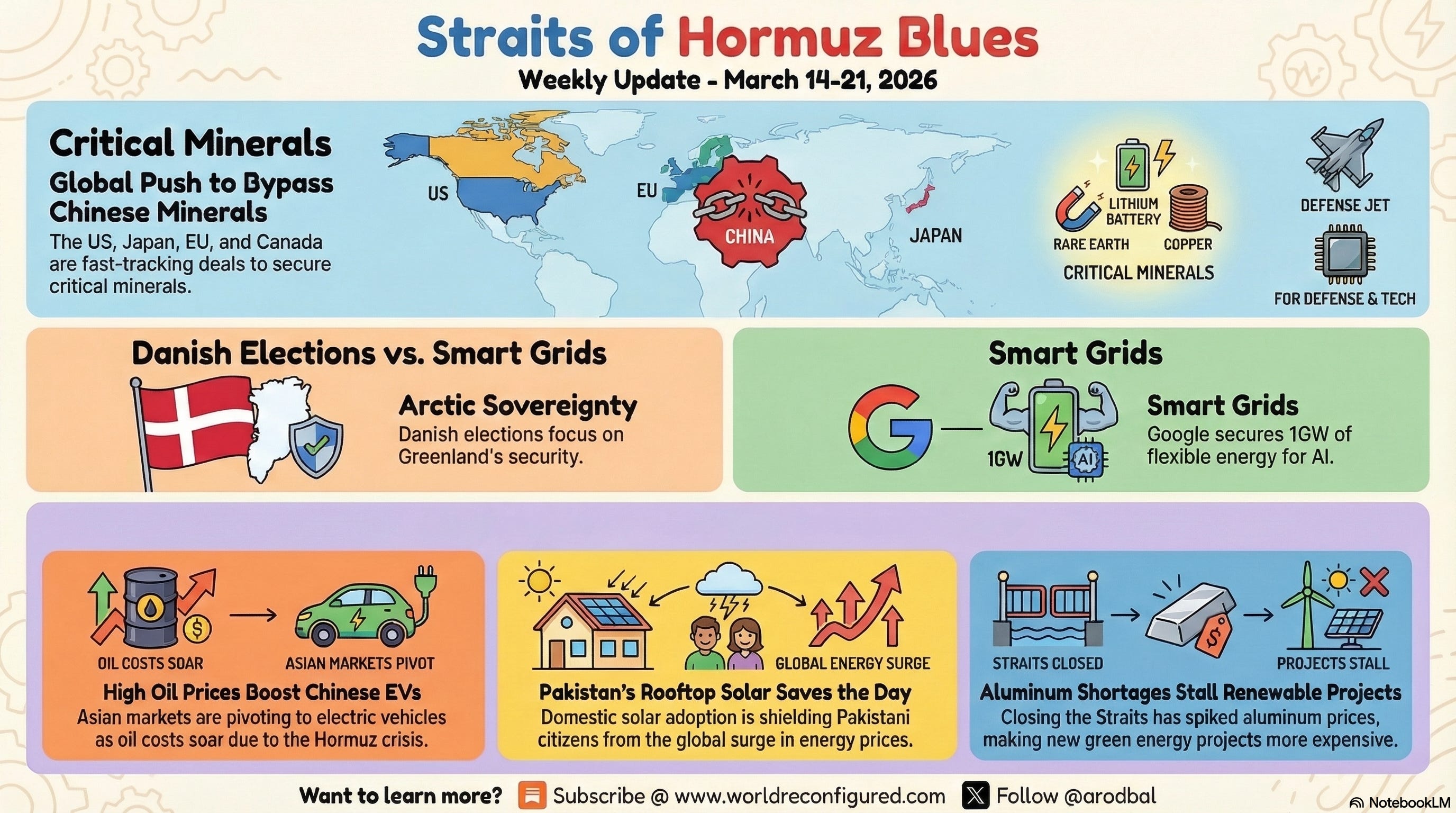
The Strait of Hormuz had a few less discussed impacts (like me getting cabin fever)
Critical Minerals had another killer week (at this rate they should have a world tour)
The Smaller Things
Thanks to Trump, Danish elections heat up while focusing on the frozen kingdom (thank you for your attention to this matter!)
Google came up with 1GW of flexible load (maybe they can make data centers a bit less unpopular)
In Other News: Climate-resistent apples, shifting tornadoes and much, much more.
The Bigger Things
The biggest stories you probably missed:
Strait of Hormuz Blues: What You’ve Missed
What Happened? Sure, everyone’s talking about the closure of the Strait of Hormuz. Everyone’s an expert on the geo-eco-political implications, and it’s clear by now its a major artery of global commodity trade:


I want to dedicate this section to three things that most people noticed less:
First, cars: The rise in oil prices thanks to the closure of the Strait led to an uptick in EV adoption, mostly in Asia. While Western countries experienced less of this trend, Asian countries like Vietnam have reported that EV sales have skyrocketed. Who benefits? China, of course, who dominates the EV market today.
Second, Pakistan: While many countries started rethinking their dependence on oil and contemplate switching to renewables to insulate themselves from similar shocks, Pakistan already managed to hedge against the impacts of the closure, thanks to its rapid adoption of solar energy, primarily of the Rooftop variety.
The scale of Pakistan’s solar adoption is supposedly enormous, but not entirely clear. Some estimates put solar to account 20% of new generation in 2024. At any rate, this adoption can serve as an example for other countries looking to insulate from such supply shocks.
Third, Solar Panels: One sector to feel the pinch is the solar industry. According to Heatmap News, Aluminum is a major victim of the closure, squeezing profit margins on solar development projects.
Why Care? 🤷♂️ Because these lesser discussed impacts can indicate much bigger shifts that are taking place, and indicate that China is not completely out of pocket when it comes to this war. Finally, Pakistan’s solar adoption might convince other countries to follow suite.
My Take: ✍️ Yeah, the closure of the Straits is important, can’t argue with that. Still, I think it will unfold long-term quite differently than what most people think.
Once Again, Minerals at the Heart of Geopolitics
What Happened? Another busy week for critical minerals.
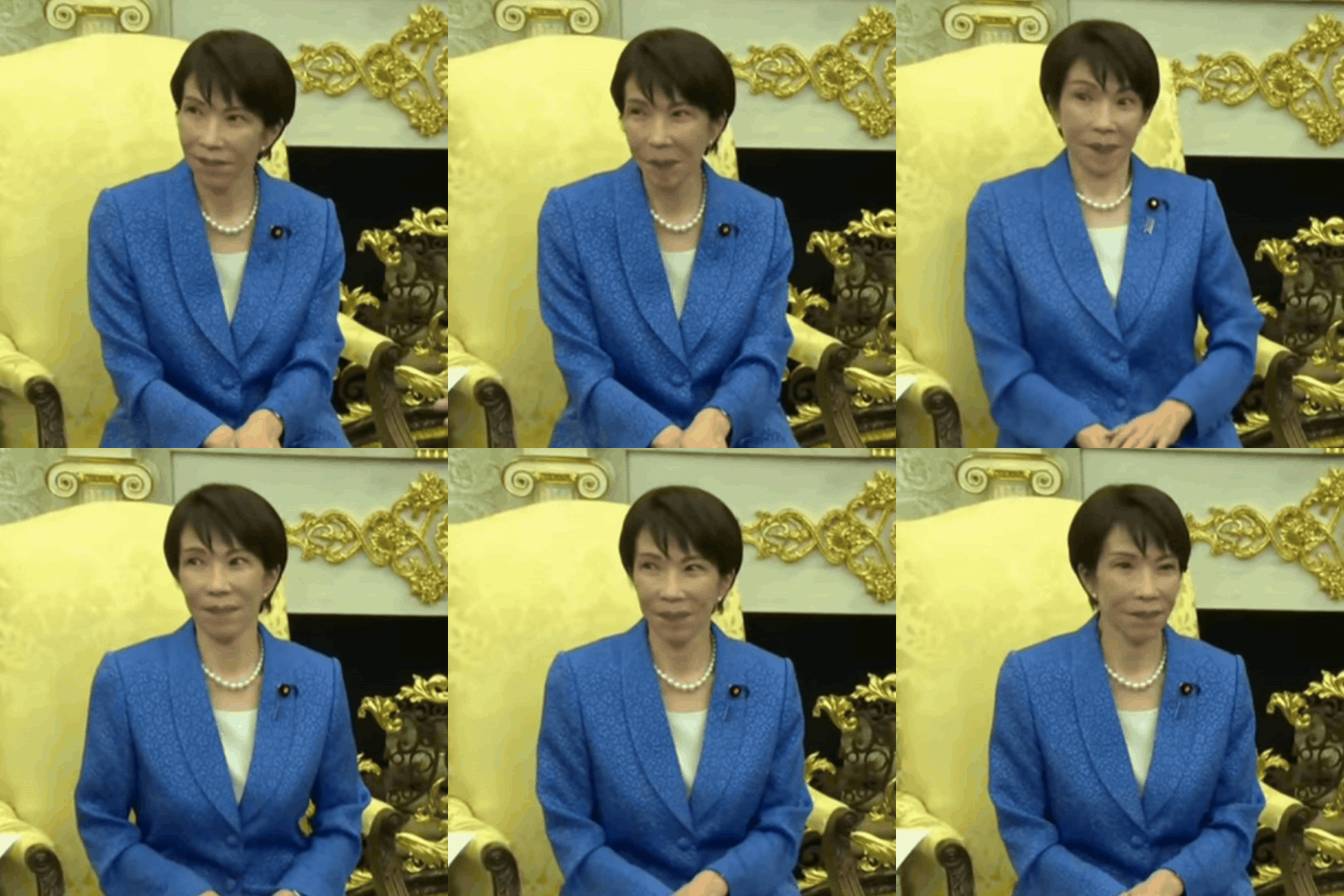
While everyone was watching the Strait, President Trump met Japanese PM Sanae Takaichi and, Pearl Harbor jokes aside, announced a joint Action Plan on critical minerals to deepen cooperation on rare earths and other key inputs.
Outside the US, Canada signed an MoU with Peru on critical-minerals mining, and the EU and Australia moved forward on a free trade deal that would give Europe better access to Australian resources. In the private sector, Aclara advanced a separation pilot in Virginia, and Lynas produced the first samarium oxide outside China, a crucial step for magnet supply chains that feed platforms like the F‑35.
Why Care? 🤷♂️ Because even with Hormuz snarling commodity flows, the push to rebuild Western supply chains and loosen China’s grip on rare earths has not slowed at all. If anything, this week underscored how quickly “mineral independence” is moving from talking point to implementation.
My Take: ✍️ None of this is shocking. Japan is jumpy about China’s threats, Canada is busy playing Middle Power, and the private sector is doing what it always does: executing. But beneath the business-as-usual mood, the race for mineral independence is clearly accelerating, and it isn’t easing off anytime soon.
The Smaller Things
The stories you should have on your radar:
There’s Something Frozen in the Kingdom of Denmark
What Happened: Denmark’s upcoming election will be a tough fight for Prime Minister Mette Frederiksen as she seeks a third term, and until recently her chances looked… not great.
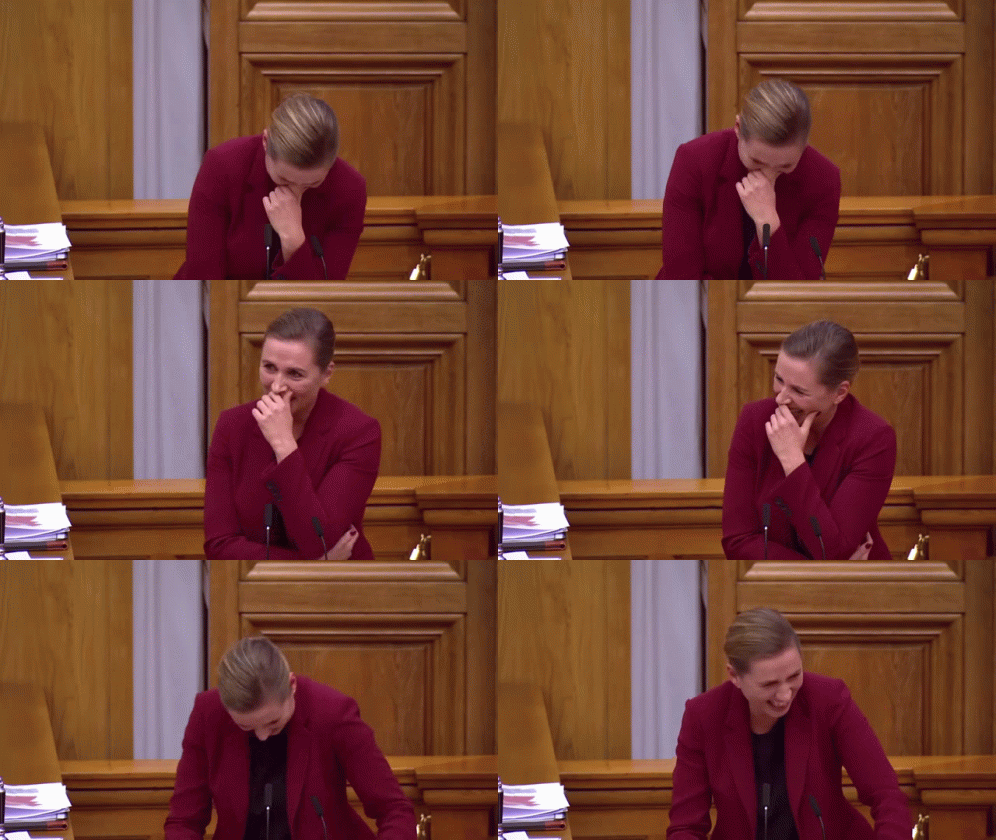
Trump has changed that calculus,
much like he did for Mark Carney. Greenland, defense, and a shifting world order are now at the center of the campaign, earning Frederiksen points for standing up to Trump, while Greenlandic politicians use the attention to press for more from Copenhagen.

Why Care? 🤷♂️ Because Denmark’s vote is an early harbinger of what’s coming: more contested, defense-heavy elections across Europe as security politics take over domestic agendas. It will also help shape the Arctic’s future, since a third Frederiksen term likely means a continued “not for sale” line on Greenland.
My Take: ✍️ Yeah, like I keep saying: The Greenland saga is nowhere near finished, and as Danes head to the polls they’ll be voting, among other things, to defend the current Arctic status quo.
Google Shows Up with Flexible Demand
What Happened: Google announced the integration of 1 gigawatt of “demand response” capacity into long‑term utility contracts, letting it shift AI workloads in times of need to help stabilize the grid and support cheaper, smarter electricity growth.
Why Care? 🤷♂️ Because just as Hyperscalers are getting much heat (and hate) for their data centers, Google is coming in the nick of time with something that might actually help prevent grid stress and might impact prices.
My Take: ✍️ Google has a long track record of backing novel energy tech and signing huge renewable deals. I’m curious to see if and to what extent they will scale this ability.
In Other News:
📰 Norwegian police shifts counter-hybrid training to Russia border amid Moscow's bill enabling armed rescues of detained citizens abroad (yeah not on my visiting destination anytime soon)
📰 South Korea creates a working group uniting government, ports, and research institutes to accelerate eco‑friendly Arctic shipping routes and technologies (can I buy one of those ships?)
📰 UK Reform Party pledges to eliminate green levies, VAT on energy bills, saving households ~£200/year amid rising oil prices (two things are certain in life: death and green taxes)
📰 US faces shifting tornado patterns with rising activity in Southeast/Northeast amid severe storms, as climate change complicates attribution amid Midwest outbreaks (I’m not going to the Midwest anytime soon either!)
📰 Denmark's rural voters backlash against sprawling solar farms ("iron fields") ahead of elections, halting projects despite 90% renewable electricity (like Frederiksen didn’t have enough on her plate…)
📰 Washington State University unveils Sunflare apple, bred for climate resilience like Cosmic Crisp but hardier against erratic weather and costs (yum!)
Thanks for reading! If you enjoyed this edition, don’t forget to subscribe or share your thoughts. 🔽
See you next week!