


👋 Welcome to A World Reconfigured - your guide to a world changed by climate, geopolitics and technology. I write about how climate change is creating a new world with new rules, and often cover topics like the ❄️Arctic, 🤷♂️Rare Earths and 💻Data Centers.
If you happened to receive this email from a friend, please consider subscribing. If you’re already a part of this community, I’d love it if you could recommend it to a friend.
TL;DR
The Bigger Things
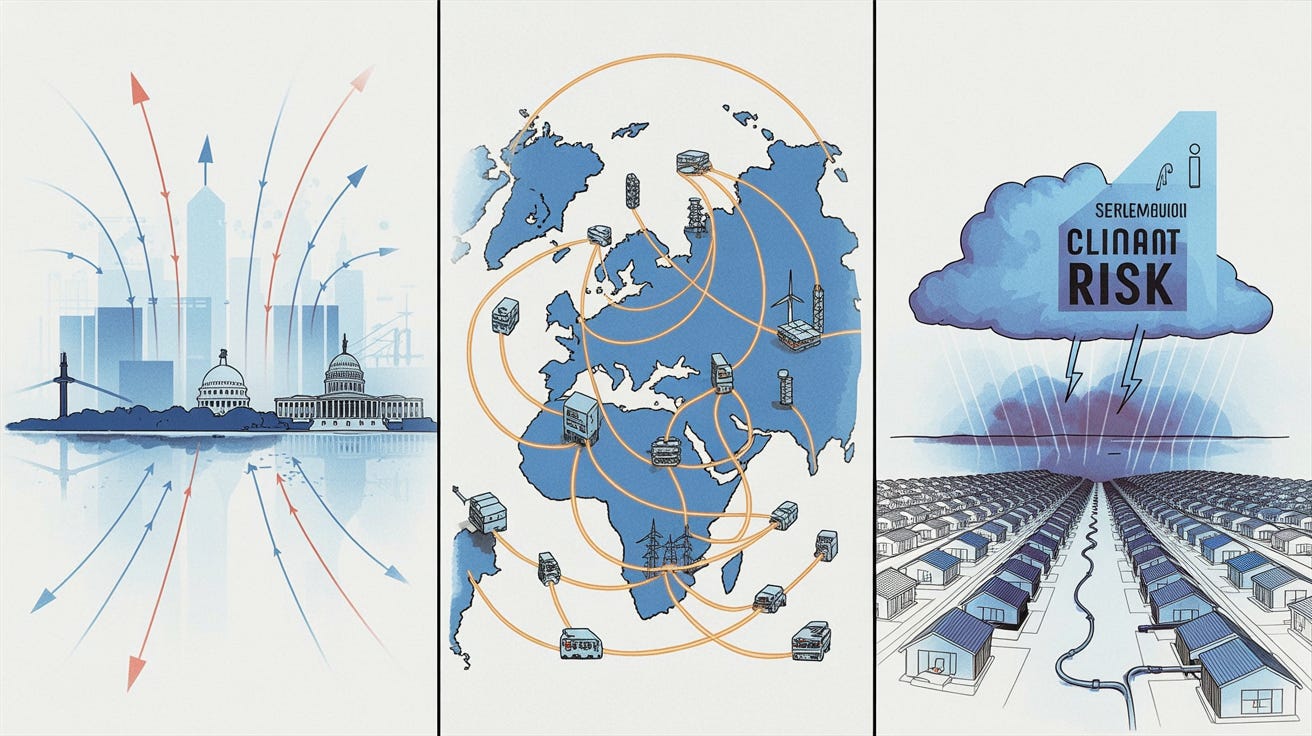
US launched a new National Security Strategy (wait where’s the Arctic in this one)
China eases rare earth element export controls (see you at the next round Beijing)
The Arctic Heats Up, Slowly (Putin makes a lot of people nervous or something)
Big week for Data Centers and Nuclear (lots of drama in DataCenterLand)
The Smaller Things
Zillow deletes its climate risk function (I guess it worked too well?)
Personal stories over the climate insurance crunch (there are people behind numbers)
The Talk of the Town
Genesis Mission, cold-war AI, AI jagged frontiers, China’s 2025 climate scores and dispatches from Aceh
Creator Spotlight
Sustainability by the Numbers (Hannah Richie breaks down climate debates with actual facts)
The Bigger Things
The biggest stories you probably missed:
US launches a new National Security Strategy
What Happened? While this is not a NatSec blog, I did want to highlight the new National Security Strategy (NSS) document published by the Trump Administration this week. This 20‑something‑page document defines (or redefines) America’s priorities in the region, while effectively declaring that America is “soo back”.
Why Care? 🤷♂️ Because this document defines the US’s national security priorities and essentially tells us how the Trump Administration sees the world. If you’ve been following US moves this past year, you probably can already guess 80% of the document.
My Take: ✍️ I’ll let the geopolitics experts weigh in, but as far as my coverage is concerned, I am somewhat surprised by the scant to no attention to the Arctic and to rare earths (only one reference), given how much attention the US gives these two topics in practice.
China Eases Rare Earth Export Controls (For Now)
What Happened? Following its announced truce with the US, China has finally issued new licenses to export rare earths. These one‑year, more flexible export licenses were given to three Chinese companies. Still, it doesn’t seem like China has changed its policies in a strategic or structural way.
Why Care? 🤷♂️ Because this looks like a tactical pause in the US‑China minerals cold war, and it’s still unclear how deep or lasting the easing will be.
My Take: ✍️ Nice move by Beijing, but I don’t see China’s move impacting the global race for mineral independence, given that the Chinese can just shut the floodgates the next time Trump gets under their skin.
The Arctic Gets Hotter, Slowly
What Happened? There’s a lot happening on the Arctic front: NATO chief Mark Rutte stopped in Reykjavik to highlight Iceland’s strategic role, NATO’s Standing Maritime Group 1 deployed to Norway’s Arctic waters, and Norway ordered more submarines for ‘turbulent times’. Oh yeah, cool as a cucumber.
Why Care? 🤷♂️ Because the Arctic is turning into a contested arena for asymmetric pressure - informational, economic and military - and Russia’s recent moves have NATO states visibly on edge.
My Take: ✍️ You’d be surprised at just how much the the Russia‑Ukraine peace talks are making Northern states nervous, many of them worried that Putin will turn to the high north next.
Big Week for Data Centers and Nuclear
What Happened? Nuclear and data centers both had a big week, full of drama and fun. Google is exploring nuclear power for an Iowa data center in Tornado Alley, and the Trump administration just committed $800M to next‑gen nuclear projects. At the same time, Georgia proposed letting data centers contract directly with clean‑energy developers, PJM’s ombudsman warned against adding more data centers to an already‑strained grid, and a new report says data centers could use about 40 percent more electricity than previously expected.
Why Care? 🤷♂️ Because the issues of data centers, the grid and nuclear power are intertwined. Whether the US can power data centers or not will have significant consequences.
My Take: ✍️ The landscape really is chaotic: tech, utilities, regulators and nuclear are all pulling in different directions, and there’s no coherent plan yet. Right now it looks less like a strategy and more like a live‑fire experiment in how far the grid can stretch.
The Smaller Things
The stories you should have on your radar:
Zillow Deletes its Climate Risk Feature
What Happened: Home‑buying platform Zillow removed a feature it launched last year that let buyers see a property’s exposure to climate risks like floods, wind and fire. The change came after real‑estate agents and homeowners complained the scores were arbitrary and hurt sales. Instead of in‑house scores, Zillow now links out to First Street, the nonprofit that powered the original tool.
Why Care? 🤷♂️ Because Zillow’s move shows two things at once: First, that climate risk warnings do in fact work (perhaps too well) and influence people’s decisions, and that the tide has in fact turned against climate monitoring and transportability. Neither is a great sign.
My Take: ✍️ I guess some things work a little too well. Zillow may solve a short‑term sales problem, but it’s inviting a longer‑term fight over how much climate risk buyers deserve to see upfront.
Home Insurance Sees Climate Crunch
What Happened: The NYT has gathered stories and evidence of how the rise in climate related disasters are influencing home insurance, chronicling everyday Americans’ encounters with increased premiums and reduced coverage.
Why Care? 🤷♂️ Because behind statistics there are people who cannot afford insurance and see their coverage declining, and the NYT has done a great job in capturing these stories.
My Take: ✍️ The Insurance market in the US is experiencing a visible and noticeable crunch that is only set to increase as the planet becomes more volatile. I suspect we will see more and more of these stories popping up, and not only during national-scale disasters.
Talk of the Town:
I read way too much Linkedin, Twitter and Substack for my own good. Here are a few of my favorites this week:
✍️ Matthew Jensen explores the Genesis Mission and an app-replacing agentic future
✍️ Jordan Schneider interviews Helen Toner about her new role at CSET, AI’s Jagged Frontier and more. It’s a wonderful interview that explores modern think-tanking and the frontiers of AI research.
✍️ Hannah Ritchie recaps 2025 for China’s energy and climate. It’s a lot more complicated than you’d think and far more nuanced.
✍️ MAATTR explores the connection between extraction economics to the recent mudslides in Aceh in a deeply personal and beautifully written essay.
✍️ David Schatsky warns of possible overinvestments in AI and brings up a Cold-War corollary
Creator Shoutout
Every week I’m going to highlight a writer/creator I am inspired by.
This week’s shoutout goes to:
Sustainability by the Numbers
Hannah Ritchie authors an excellent evidence-based substack dedicated to bringing balance and nuance to the sustainability debate.
Her writing is accessible and engaging and makes delving into the data fun and easy. Reading Ritchie’s blog, it is easy to orient around hard cold facts that are often confusing and locked away in complex industry jargon.
Personally, I can’t wait to read the next post and make sure to look at her work to inform my own writing.
Check it out here!
Thanks for reading! If you enjoyed this edition, don’t forget to subscribe or share your thoughts. 🔽
See you next week!